Lazarus has been in the tomb four days by the time Jesus arrives in Bethany. In that culture, four days mattered—it was long enough that decay was assumed to have set in, long enough that any hope of the kind of resuscitation Jesus had performed elsewhere would have seemed absurd. Martha meets Him on the road with grief sharpened by a very specific regret: “Lord, if you had been here, my brother would not have died” (John 11:21).
She is not wrong that Jesus could have prevented it. John has already told the reader that Jesus, on hearing Lazarus was ill, deliberately “stayed two days longer in the place where he was” (John 11:6) before setting out—a delay He Himself says was “for the glory of God, so that the Son of God may be glorified through it” (John 11:4). Martha’s grief and Jesus’ purpose are both entirely real, held together without either one cancelling the other.
Into that grief Jesus speaks the boldest of all eight declarations: “I am the resurrection and the life. Whoever believes in me, though he die, yet shall he live, and everyone who lives and believes in me shall never die. Do you believe this?” (John 11:25–26). This is not a promise about someday. It is a claim about who is standing in front of her right now.
I AM THE RESURRECTION AND THE LIFE, AT A GLANCE
Reference: John 11:25. Validating sign: the raising of Lazarus after four days in the tomb (John 11:17–44)—the last and greatest of the seven signs recorded in John’s Gospel. Old Testament root: Israel’s hope of bodily resurrection, voiced in Isaiah 26:19 (“your dead shall live”) and Daniel 12:2 (“many… shall awake”). Core claim: Jesus does not merely promise a future resurrection—He claims to be resurrection and life in His own person, so death loses its final word over everyone who believes in Him.
This post is Part 6 of a series on Jesus’ eight “I am” statements. Start with the series introduction for the full roadmap.
The Miracle That Validates the Claim
John structures his Gospel around seven signs, each one building the case for who Jesus is. This is the last of them, positioned deliberately right before the events that lead to Jesus’ own death—He restores someone else’s life at the direct cost of provoking the plot against His own.
| STAGE | JOHN 11 REFERENCE | WHAT HAPPENS |
|---|---|---|
| News arrives, Jesus delays | 11:1–6 | Jesus hears Lazarus is ill, yet stays two more days, “so that the Son of God may be glorified through it” |
| Martha meets Him | 11:17–27 | Lazarus is already four days in the tomb; Martha’s “if you had been here” meets Jesus’ declaration and her confession, “I believe that you are the Christ” |
| Mary and the mourners | 11:28–37 | Mary repeats her sister’s words; seeing the weeping crowd, Jesus is “deeply moved” and “wept” |
| At the tomb | 11:38–40 | Jesus orders the stone removed despite Martha’s warning about the smell; “Did I not tell you that if you believed you would see the glory of God?” |
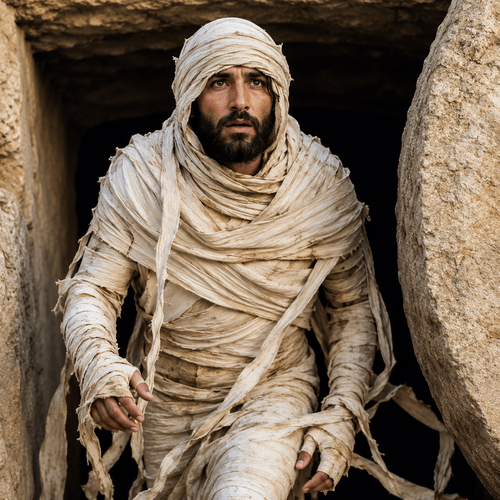
| The raising | 11:41–44 | Jesus prays aloud, then cries, “Lazarus, come out”—and the dead man walks out, still wrapped in graveclothes |
| The aftermath | 11:45–53 | Many believe, but the sign also triggers the formal decision to kill Jesus, sealing the path to His own death |
No other sign in John’s Gospel carries this cost so visibly. The very miracle that proves Jesus has authority over death is the miracle that sets in motion His own.
A Promise Brought Forward
Israel had held on to the hope of bodily resurrection for centuries as a promise pointing toward the future—a day still ahead, at the end of history. Jesus’ declaration takes that same hope and relocates it in the present tense, in Himself.
| ISAIAH 26 / DANIEL 12 | THE RESURRECTION AND THE LIFE (JOHN 11) | |
|---|---|---|
| Source | A promise spoken through the prophets, pointing ahead to a coming event | Located in Jesus Himself, in the present tense—“I am,” not “I will one day bring about” |
| Timing | “At that time”—a single event set at the end of the age (Daniel 12:1–2) | Both now and then—spiritual life begins at belief, bodily resurrection is guaranteed to follow (John 11:25–26) |
| Scope | A general resurrection of “many,” some to life, some to shame (Daniel 12:2) | Personal and immediate—“whoever believes,” tied to union with a specific person, not a general event |
| Outcome | A hope Israel carried through generations of suffering, unseen and unproven | A guarantee anchored in a sign already witnessed—Lazarus walking out of his own tomb |
The prophets gave Israel something true to hope for. Jesus gives something true to stand on—a promise no longer waiting to be tested, because it had just been demonstrated in front of witnesses.
I Am the Resurrection and the Life (John 11:25–26)
The declaration has two halves, and both matter. “Though he die, yet shall he live” concerns physical death—believers still die, exactly as Lazarus did, but death does not get the final word over them. “Everyone who lives and believes in me shall never die” concerns something deeper still—the true life a believer already possesses is never actually interrupted, in the way Jesus had already put it elsewhere: such a person “has passed from death to life” (John 5:24).
Then comes the question no other “I am” statement asks so directly: “Do you believe this?” Every declaration in this series makes a claim. This one demands an answer, put to Martha in her grief, and left standing open for every reader since.
WHY DID JESUS WEEP, KNOWING WHAT HE WAS ABOUT TO DO?
“Jesus wept” (John 11:35), the Bible’s shortest verse, comes only minutes before He raises Lazarus. His tears are not confusion or helplessness—He already knows exactly what He is about to do. They are grief at death itself, at what it does to the people He loves, even while He holds the power to undo it. Compassion and power are not shown here as alternatives. Both are fully present in the same moment.
Older Roots: Resurrection Hope Before the Empty Tomb
Isaiah and Daniel are the clearest Old Testament voices behind this claim, but the hope of life beyond death runs further back than either of them.
| PASSAGE | WHAT HAPPENS | CONNECTION TO JOHN 11 |
|---|---|---|
| Job 19:25–27 | “I know that my Redeemer lives, and at the last he will stand upon the earth… I shall see God” | One of Scripture’s earliest statements of personal hope for bodily life beyond death |
| 1 Kings 17:17–24 | Elijah raises the widow of Zarephath’s son | Establishes resurrection as something God’s prophets could perform by His power, on a smaller scale, centuries earlier |
| 2 Kings 4:32–37 | Elisha raises the Shunammite woman’s son | A second prophetic precedent, reinforcing that raising the dead was understood as an act of God alone |
| Isaiah 26:19 | “Your dead shall live; their bodies shall rise… the earth will give birth to the dead” | A direct prophetic promise of bodily resurrection, quoted in the background of Jesus’ claim |
| Daniel 12:2 | “Many of those who sleep in the dust of the earth shall awake, some to everlasting life, and some to shame” | The clearest Old Testament statement of a final, universal resurrection—the hope Martha herself names in John 11:24 |
Every one of these passages points forward. Job hopes. Elijah and Elisha perform a sign that lasts only for a lifetime. Isaiah and Daniel promise a day still to come. John 11 is the moment the whole line of hope, sign, and promise converges on a single person standing at a tomb.
What This Means for the Church
The claim reframes what grief is allowed to look like for a Christian. Jesus wept at a grave He was about to empty—compassion for real loss is not incompatible with certain hope. A church that rushes past grief in the name of resurrection hope misrepresents the very Lord who modelled both together.
It also reframes what security looks like now, not only at the end. “Everyone who lives and believes in me shall never die” is not a promise deferred to some future funeral. It describes a life already possessed, already unbreakable, carried by someone who has already proven He can call the dead by name and be obeyed.
Tough Questions, Honest Answers
Lazarus died again later—so is this really the same resurrection Jesus promises to believers?
No. Lazarus was resuscitated back into ordinary mortal life, and he would die again like everyone else. The resurrection Jesus promises—and later demonstrates in His own body—is to imperishable life that death can never touch a second time: “sown perishable, raised imperishable” (1 Corinthians 15:42). Lazarus’s raising is a sign pointing toward that greater resurrection, not an example of it.
If Jesus loved Lazarus, Martha and Mary, why did He deliberately delay two days, letting Lazarus die in the meantime?
John frames the delay as purposeful rather than careless: “so that the Son of God may be glorified” (11:4), and Jesus later tells the disciples He was “glad” He was not there sooner, “so that you may believe” (11:15). That does not erase the real grief the delay caused Martha and Mary in those days—Scripture does not minimise it—but it places that grief inside a purpose that would ultimately overturn it.
Does “everyone who lives and believes in me shall never die” (John 11:26) mean Christians don’t experience physical death at all?
No—the verse itself distinguishes two senses of death. “Though he die” (11:25) plainly allows for physical death, exactly as Lazarus and every believer since has experienced it. “Shall never die” (11:26) concerns the deeper life a believer already possesses in Christ, which physical death cannot interrupt or end.
Martha already believed in a future resurrection (“I know that he will rise again… on the last day,” 11:24)—so what did Jesus’ declaration actually add for her?
It moved her hope from a doctrine about someday to a person available today. Martha had the right belief about a coming event; Jesus relocates that hope in Himself, present tense. Her response shows she understood the shift: “I believe that you are the Christ, the Son of God” (11:27) is a statement about a person, not merely about an event she now trusted more firmly.
Why did raising Lazarus lead directly to the plot to kill Jesus (John 11:45–53) instead of convincing the religious leaders?
Their own recorded reasoning was practical and political, not evidential: “If we let him go on like this, everyone will believe in him, and the Romans will come and take away both our place and our nation” (11:48). The sign itself was not in doubt—what followed was a choice, not a failure of evidence. John even records Caiaphas unknowingly prophesying the very salvation his plot was meant to prevent (11:49–52).
Is there a real difference between Jesus saying “I am the resurrection and the life” and simply saying “I will raise the dead on the last day”?
Yes, and it is the same shift Martha experienced. One statement describes an act Jesus will perform someday. The other describes who He already is. Resurrection and life are not powers Jesus merely wields on a future date—they are His own identity now, which is why union with Him today, not just correct belief about a future event, is what secures the outcome.
How does raising Lazarus—a miracle done for someone else—actually prove anything about Jesus’ own resurrection?
It establishes the same authority that would soon raise Jesus Himself, with one telling difference Jesus points out elsewhere. Lazarus was raised by a power acting on him from outside the tomb. Of His own life, Jesus said, “I have authority to lay it down, and I have authority to take it up again” (John 10:18). Lazarus’s sign proves Jesus holds resurrection power over others. The empty tomb, a few chapters later, proves He holds it over Himself—the greater and final proof the whole Gospel has been building toward.
Continue the Series
THIS IS PART 6 OF 9
Jesus makes eight “I am” declarations in Scripture, each validated by a sign and rooted in the Old Testament. Read the series introduction for the full roadmap, including the Bread of Life, the Light of the World, the Door, the Good Shepherd, the Way the Truth and the Life, the True Vine, and the Alpha and Omega.
Related Reads
- Jesus’ ‘I AM’ Statements: Proclamations of Deity (Series Introduction)
- I Am the Bread of Life: Why Some Followers Walked Away (John 6:35)
- I Am the Light of the World: Sight Given, Sight Refused (John 8:12)
- I Am the Door: The Only Way Into the Fold (John 10:7)
- I Am the Good Shepherd: A Death Freely Chosen (John 10:11)
- I Am the Way, the Truth, and the Life: One Claim, Not Three (John 14:6)
- I Am the True Vine: What Israel’s Golden Vine Could Not Be (John 15:1)
- I Am the Alpha and the Omega: Every Story’s Beginning and End (Revelation 1:8)