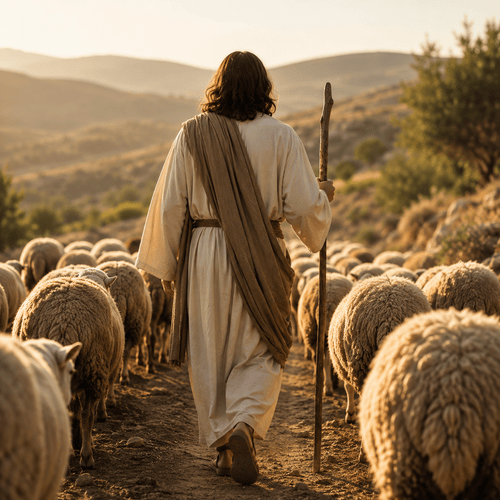
Jesus has not changed the subject. Still speaking to the same Pharisees who had just excommunicated a healed beggar (John 9:34), still using the same sheepfold He has just described, He moves from the door to the one who stands at it. “I am the good shepherd,” He says. “The good shepherd lays down his life for the sheep” (John 10:11).
Every other “I am” statement in this series is validated by something Jesus does for someone else—feeding a crowd, opening blind eyes, healing a man who could not walk. This one is different. The sign that proves “I am the good shepherd” is not a miracle performed on another person. It is Jesus’ own death, chosen freely and taken back again exactly as He said He would.
“No one takes it from me, but I lay it down of my own accord. I have authority to lay it down, and I have authority to take it up again” (John 10:17–18). Three years before the cross, He had already told them precisely what was going to happen and precisely why it would not be a defeat.
I AM THE GOOD SHEPHERD, AT A GLANCE
Reference: John 10:11, 14. Validating sign: His own death, prophesied in advance and fulfilled on the cross (John 10:11; 19:30). Old Testament root: Psalm 23, and God’s promise to shepherd His scattered people Himself (Ezekiel 34:11–31). Core claim: Jesus is not a hired hand guarding sheep that belong to someone else—He is the owner who lays down His own life for what is His own, and takes it back on His own authority.
This post is Part 5 of a series on Jesus’ eight “I am” statements. Start with the series introduction for the full roadmap.
The Sign That Validates the Claim: A Death Freely Chosen
Because the sign here is Jesus’ own death and resurrection rather than a miracle performed on someone else, the proof takes the shape of prediction and fulfilment. Jesus states, in advance, exactly what kind of death He will die and exactly what will happen afterward—and then it happens precisely that way.
| PREDICTION (JOHN 10) | FULFILMENT | SIGNIFICANCE |
|---|---|---|
| “The good shepherd lays down his life for the sheep” (10:11, 15) | “He bowed his head and gave up his spirit” (John 19:30) | A death described as an act He performed, not simply one that happened to Him |
| “I have authority to lay it down, and I have authority to take it up again” (10:17–18) | The resurrection (John 20:1–18; Luke 24:1–12) | He retained sovereign control over death itself, exactly as He had already claimed |
| Contrast with the hired hand, who flees when danger comes (10:12–13) | Peter flees and denies Him three times (Matthew 26:69–75), yet is personally restored (John 21:15–17) | Even a disciple’s hired-hand moment does not end the story, because the shepherd does not abandon what is His |
| “I have other sheep that are not of this fold… so there will be one flock, one shepherd” (10:16) | The gospel’s spread to the Gentiles (Acts 10; Ephesians 2:11–18) | The shepherd’s reach extends, exactly as promised, beyond the audience standing in front of Him that day |
No other sign in this series works quite like this one. The healings prove Jesus has authority over sickness. This sign proves He has authority over the one thing no ordinary person controls at all—the timing and terms of His own death.
A Shepherd Unlike the Hired Hand
The contrast Jesus draws would have been familiar to anyone who had worked with sheep. A hired hand is paid to watch a flock that belongs to someone else. When a wolf appears, he runs, “because he is a hired hand and cares nothing for the sheep” (John 10:13). The owner has no such option. What is his own, he protects at cost to himself.
This is the shape of shepherding language running all the way back through Israel’s Scriptures, and Jesus is claiming to fulfil it exactly.
| PSALM 23 / EZEKIEL 34 | THE GOOD SHEPHERD (JOHN 10) | |
|---|---|---|
| Care | “He makes me lie down in green pastures… he leads me” (Psalm 23:2–3) | “I know my own and my own know me” (John 10:14)—provision grounded in personal relationship |
| Danger | “Even though I walk through the valley of the shadow of death, I will fear no evil, for you are with me” (Psalm 23:4) | The shepherd does not merely walk beside the sheep through death—He walks into it, in their place (John 10:11) |
| Failed leadership | “The shepherds of Israel… have not strengthened the weak” (Ezekiel 34:2–4) | Directly contrasted with the hired hand who flees (John 10:12–13) |
| Promise | “I will set up over them one shepherd, my servant David… and make with them a covenant of peace” (Ezekiel 34:23, 25) | “I give them eternal life, and they will never perish, and no one will snatch them out of my hand” (John 10:28) |
Ezekiel’s promise names a coming shepherd descended from David who would succeed where Israel’s kings had failed. John 10 claims that promise has arrived, and that its guarantee is stronger than anything a human king could offer.
I Am the Good Shepherd (John 10:11, 14)
The word translated “good” here is not the ordinary word for morally good, but one that carries the sense of noble, genuine, the real article rather than a counterfeit. Jesus is not simply claiming to be a kind shepherd. He is claiming to be the one shepherd who actually is what the title requires, in contrast to every hired hand and false leader who has worn the name without earning it.
That claim is grounded in something even larger than sacrifice. “I know my own and my own know me, just as the Father knows me and I know the Father” (John 10:14–15). The shepherd’s knowledge of His sheep is set on the same level as the Father’s knowledge of the Son—an ordinary pastoral image suddenly opening onto the relationship within the Trinity itself.
WHY “GOOD” MEANS MORE THAN “NICE”
The Greek word behind “good shepherd” (kalos) describes something admirable in its very nature—beautiful, genuine, the standard against which counterfeits are measured—rather than simply pleasant or well-meaning. Jesus is not claiming to be an agreeable shepherd. He is claiming to be the real one, the pattern every other shepherd is measured against and falls short of.
Older Roots: Shepherd as a Sign of God’s Rule and Care
Ezekiel 34 is the most direct Old Testament background to this claim, but the shepherd image runs through the whole of Israel’s story, from the patriarchs to the prophets.
| PASSAGE | WHAT HAPPENS | CONNECTION TO JOHN 10 |
|---|---|---|
| Genesis 48:15 | Jacob blesses his grandsons, calling God the one “who has been my shepherd all my life long” | Establishes shepherd as a personal, lifelong description of God’s care, generations before the exodus |
| Psalm 23:1–4 | David describes the Lord as a shepherd who provides, guides, and stays present through the valley of death’s shadow | The most familiar Old Testament template behind John 10’s imagery of care |
| Isaiah 40:11 | “He will tend his flock like a shepherd… he will gently lead those that are with young” | Anticipates a coming, gentler shepherd-ministry fulfilled in Christ |
| Ezekiel 34:11–23 | God rebukes Israel’s failed shepherds and promises to search for and shepherd His flock Himself, through “my servant David” | The direct Old Testament root behind “I am the good shepherd” |
| Zechariah 13:7 | “Strike the shepherd, and the sheep will be scattered” | Quoted by Jesus of Himself the night before His death (Matthew 26:31), predicting the disciples’ scattering at His arrest |
By the time Jesus speaks in John 10, “shepherd” was not a neutral farming term. It was a title Israel’s Scriptures had reserved, again and again, for God Himself and for the king He would one day send.
What This Means for the Church
The claim sets a standard for every leader who has ever taken responsibility for other people’s souls. “Shepherd the flock of God that is among you… not for shameful gain, but eagerly; not domineering over those in your charge, but being examples to the flock” (1 Peter 5:2–3). A church leader is not the owner of the sheep. They serve on behalf of the one who is—and their conduct is measured against how closely it resembles His.
For everyone else, the claim is a promise about being known, not merely managed. “I know my own and my own know me” describes something closer than supervision. It is the reason a sheep who has wandered can be found and carried back, rather than simply written off as lost.
Tough Questions, Honest Answers
Wasn’t Jesus’ death forced on Him by Rome and the religious leaders? How can He say “no one takes it from me” (John 10:18)?
Scripture holds both truths together without treating them as a contradiction: “this Jesus, delivered up according to the definite plan and foreknowledge of God, you crucified and killed by the hands of lawless men” (Acts 2:23). Human choices were entirely real—Judas betrayed Him, Pilate condemned Him, soldiers carried it out. But Jesus also says He could have called “more than twelve legions of angels” to stop it (Matthew 26:53) and chose not to, and even the manner of His death was unusual enough that the Roman centurion overseeing it was “surprised to hear that he should have already died” so quickly (Mark 15:44). Both the human agency and the divine authority are real; neither cancels the other out.
Is “the good shepherd” the same image as Psalm 23, or does John 10 add something new to it?
It develops the image rather than repeating it. In Psalm 23, the shepherd walks with the sheep through “the valley of the shadow of death” and brings them safely out the other side. In John 10, the shepherd walks into death itself, in the sheep’s place, so they do not have to face it alone or unrescued. The comfort of Psalm 23 becomes, in Christ, a rescue.
Who are the “other sheep… not of this fold” in John 10:16—does this support the idea that everyone is saved regardless of belief?
No. It refers to Gentile believers who would be brought into the one flock as the gospel spread beyond Israel, fulfilled in the book of Acts and the letters that follow it. “I must bring them also” describes a mission that was still to be carried out through preaching and belief, not a guarantee that everyone is automatically included without response. The New Testament consistently pairs this promise with an active call to hear and follow the shepherd’s voice (John 10:27).
Why does the “hired hand” contrast matter for evaluating church leadership today?
It gives a concrete test. A hired hand serves for pay, flees when it costs him something, and treats the sheep as replaceable. Peter’s instruction to elders draws the same line: shepherd “not for shameful gain… not domineering over those in your charge” (1 Peter 5:2–3). The question worth asking of any leader is not simply whether they teach accurately, but whether they stay when staying is costly.
Does “no one will snatch them out of my hand” (John 10:28) mean a believer can never lose their salvation, no matter what?
John 10:28–29 states the promise in the strongest possible terms, and it is one of the central texts behind the doctrine of the perseverance of the saints. Christian traditions differ on exactly how this promise interacts with warnings elsewhere in Scripture about falling away (such as Hebrews 6:4–6)—some read those warnings as describing people who were never truly regenerate to begin with, others read them as a genuine danger held in tension with this promise. What the text itself does not leave ambiguous is the security it offers to those who are, in fact, the shepherd’s sheep: nothing external can pull them out of His hand.
Is “he calls his own sheep by name” (John 10:3) a figure of speech, or did shepherds really do this?
It reflects a real, documented practice. Ancient Near Eastern shepherds, unlike shepherds who drive a flock from behind, typically led from the front and called individual sheep by name, and travellers to the region have long recorded flocks that respond to a familiar voice while ignoring a stranger’s. The image is not simply poetic. It is drawn from an actual method of shepherding that made personal, individual knowledge—not anonymous crowd management—the ordinary experience of every sheep in the flock.
Jesus claims authority to take up His life again (John 10:18)—so was the resurrection His own doing, or the Father’s, as other passages say (Acts 2:24)?
Scripture attributes the resurrection to the Father (Acts 2:24; Romans 6:4), to the Spirit (Romans 8:11), and to the Son Himself (John 10:18; John 2:19–21) without treating any of these as competing claims. The resurrection, like every act of God toward creation, is the united work of the one triune God. Jesus’ claim to authority over His own life does not exclude the Father’s role—it is itself a claim to full participation in that single divine act.
Continue the Series
THIS IS PART 5 OF 9
Jesus makes eight “I am” declarations in Scripture, each validated by a sign and rooted in the Old Testament. Read the series introduction for the full roadmap, including the Bread of Life, the Light of the World, the Door, the Resurrection and the Life, the Way the Truth and the Life, the True Vine, and the Alpha and Omega.
Related Reads
- Jesus’ ‘I AM’ Statements: Proclamations of Deity (Series Introduction)
- I Am the Bread of Life: Why Some Followers Walked Away (John 6:35)
- I Am the Light of the World: Sight Given, Sight Refused (John 8:12)
- I Am the Door: The Only Way Into the Fold (John 10:7)
- I Am the Resurrection and the Life: Four Days Too Late? (John 11:25)
- I Am the Way, the Truth, and the Life: One Claim, Not Three (John 14:6)
- I Am the True Vine: What Israel’s Golden Vine Could Not Be (John 15:1)
- I Am the Alpha and the Omega: Every Story’s Beginning and End (Revelation 1:8)
- John 10:16 Meaning: Who Are Jesus’ “Other Sheep”?