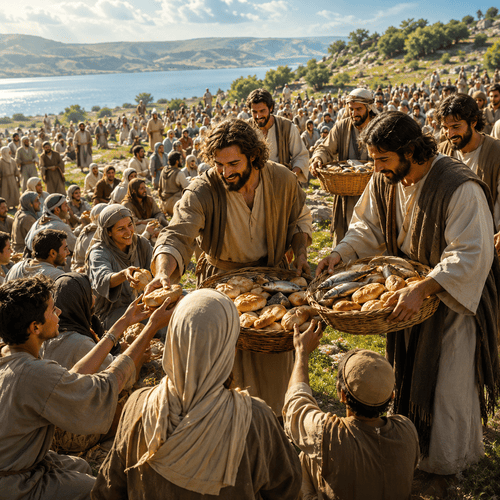
It is the morning after the miracle. The evening before, Jesus took five barley loaves and two small fish from a boy’s lunch and fed a crowd of more than five thousand people until they were full, with twelve baskets left over. Now the crowd has tracked Him down on the far side of the lake, and they are hungry again.
Jesus does not feed them a second time. Instead He tells them the truth about why they came: “you are seeking me, not because you saw signs, but because you ate your fill of the loaves” (John 6:26). Then He says something far stranger than another miracle. “I am the bread of life; whoever comes to me shall not hunger, and whoever believes in me shall never thirst” (John 6:35).
By the end of the conversation that follows, many of the people who had just eaten from His hands will walk away and stop following Him. This is the only one of Jesus’ “I am” statements that costs Him disciples on the spot. Understanding why gets us to the heart of what the claim actually means.
I AM THE BREAD OF LIFE, AT A GLANCE
Reference: John 6:35. Validating sign: the feeding of the 5,000 (John 6:1–14), the only miracle recorded in all four Gospels. Old Testament root: the manna God gave Israel in the wilderness (Exodus 16). Core claim: Jesus is not offering more food but is Himself the sustenance that satisfies the soul permanently—“whoever comes to me shall not hunger, and whoever believes in me shall never thirst” (John 6:35).
This post is Part 2 of a series on Jesus’ eight “I am” statements. Start with the series introduction for the full roadmap.
The Miracle That Validates the Claim
Every one of Jesus’ “I am” statements in John’s Gospel is anchored to a sign. This is the only one anchored to a sign so significant that all four Gospel writers thought it worth recording—the sole miracle, apart from the resurrection, that appears in Matthew, Mark, Luke and John alike.
| GOSPEL | REFERENCE | DETAIL IT ADDS |
|---|---|---|
| Matthew | 14:13–21 | Jesus withdraws after hearing of John the Baptist’s death; He has compassion on the crowd and heals the sick before feeding them |
| Mark | 6:30–44 | The disciples’ blunt despair—“shall we go and buy two hundred denarii worth of bread?”—and the crowd seated in ordered groups on the green grass |
| Luke | 9:10–17 | Placed immediately before Peter’s confession that Jesus is “the Christ of God” (9:20), tying the meal to the question of who Jesus is |
| John | 6:1–14 | Names Philip and Andrew, names the boy’s five barley loaves and two fish, and records the crowd’s response: they try to make Jesus king by force |
John alone tells us what happened next: the crowd, having just eaten free bread supplied out of nothing, tried to seize Jesus and crown Him king (John 6:15). He withdrew from them. The miracle proved something true about who He was—but the crowd’s instinct was to make Him useful rather than to worship Him. Everything that follows in John 6 is Jesus correcting that instinct.
From Free Bread to a Hard Question
When the crowd catches up with Him across the lake, Jesus does not indulge the request for more food. He redirects them: “Do not labour for the food that perishes, but for the food that endures to eternal life, which the Son of Man will give to you” (John 6:27).
The crowd’s reply reveals what they are actually thinking about. They bring up Moses. “Our fathers ate the manna in the wilderness… What sign do you do, that we may see and believe you?” (John 6:30–31). It is a pointed comparison: Moses fed an entire nation with bread from heaven for forty years. One afternoon of loaves does not obviously outrank that.
Jesus’ answer corrects the comparison at its root. “It was not Moses who gave you the bread from heaven, but my Father gives you the true bread from heaven. For the bread of God is he who comes down from heaven and gives life to the world” (John 6:32–33). Moses was never the source. He was the deliveryman. The true bread was always going to come from the Father directly—and it has now arrived, standing in front of them.
| MANNA (EXODUS 16) | THE BREAD OF LIFE (JOHN 6) | |
|---|---|---|
| Source | Given through Moses, at God’s command | Given directly by the Father; Jesus does not merely deliver it, He is it |
| Duration | Fell fresh every morning; spoiled and bred worms if kept overnight (Exodus 16:20) | Received once, by faith, and never needs replacing—“whoever believes has eternal life” (John 6:47) |
| What it fed | The body, for one more day in the wilderness | The soul, permanently—“I will raise him up on the last day” (John 6:40) |
| Outcome for those who ate it | “Your fathers ate the manna in the wilderness, and they died” (John 6:49) | “If anyone eats of this bread, he will live forever” (John 6:51) |
The manna was a real gift and a genuine picture of God’s provision. But it was never meant to be the final word. It fed one generation for one journey. Jesus is claiming to feed every generation for eternity.
I Am the Bread of Life (John 6:35)
This is where the declaration itself lands: “I am the bread of life; whoever comes to me shall not hunger, and whoever believes in me shall never thirst.” Notice the shape of the sentence. Coming to Him and believing in Him are placed side by side as the same act described twice. This is not bread that must be earned, worked for, or repeatedly re-supplied. It is bread that is received once, by trust, and that satisfies for good.
That claim is bound up with a second one Jesus makes only a few verses later, and it is the more staggering of the two: “All that the Father gives me will come to me, and whoever comes to me I will never cast out” (John 6:37). The bread of life is not a resource Jesus distributes from a distance. It is Himself, freely and permanently given to everyone the Father sends to Him.
The Hard Teaching That Followed
Jesus does not stop at a comfortable metaphor. He presses the image further than His audience wanted it to go: “unless you eat the flesh of the Son of Man and drink his blood, you have no life in you” (John 6:53).
To a Jewish audience raised on the law’s repeated ban on consuming blood in any form (Leviticus 17:10–14), this was not a gentle turn of phrase. It was deliberately shocking. Jesus was not instructing a crowd on cannibalism, and He was not, at this moment, instituting the Lord’s Supper—that meal would not exist for another year. He was insisting, in the most visceral language available to Him, that trusting Him is not admiration from a distance. It is total, personal dependence on His coming death, as real and as necessary as food is to a starving body. He later clarifies the terms Himself: “It is the Spirit who gives life; the flesh is no help at all. The words that I have spoken to you are spirit and life” (John 6:63). The eating is not physical. The dependence it pictures is completely real.
WHY THE LANGUAGE HAD TO BE THIS BLUNT
A polite metaphor would have let the crowd stay comfortable. “Eat my flesh, drink my blood” did not. Jesus wanted them to feel exactly how total the dependence He was describing really is—not admiration, not association, but a hunger that only His death could satisfy.
Why the Crowd Walked Away
The reaction was immediate. “This is a hard saying; who can listen to it?” (John 6:60). John records what happened next in a single stark sentence: “After this many of his disciples turned back and no longer walked with him” (John 6:66).
This is the only place in the Gospels where an “I am” statement visibly costs Jesus followers on the spot. He does not chase after them or soften the claim to win them back. Instead He turns to the twelve and asks, “Do you want to go away as well?” (John 6:67). Peter’s answer is the turning point of the whole chapter: “Lord, to whom shall we go? You have the words of eternal life, and we have believed, and have come to know, that you are the Holy One of God” (John 6:68–69).
The crowd wanted a king who would keep the bread coming. Peter had understood something different: that there was nowhere else to go, because only Jesus actually had what he needed. That is the difference the whole chapter is built to expose.
Older Roots: Bread as a Sign of God’s Presence
Manna is the most obvious Old Testament background to this claim, but it is not the only one. Bread carries this meaning throughout the Old Testament story.
| PASSAGE | WHAT HAPPENS | CONNECTION TO JOHN 6 |
|---|---|---|
| Exodus 16 | God feeds Israel with manna in the wilderness for forty years | The direct comparison the crowd itself raises (John 6:31) |
| Exodus 25:30 | Bread of the Presence is kept continually on a table in the tabernacle, before the Lord | Bread as a permanent sign of God dwelling with His people, not a one-time provision |
| 1 Kings 17:8–16 | A widow’s jar of flour does not run out during a famine, through Elijah | Bread multiplied through God’s prophet as proof of His word |
| 2 Kings 4:42–44 | Elisha feeds a hundred men with twenty loaves of barley bread, with some left over | The closest Old Testament precedent to the feeding of the 5,000—a prophet, a small quantity of barley loaves, a crowd fed, and food remaining |
The Elisha miracle in particular deserves more attention than it usually gets. Twenty barley loaves feed a hundred men, with bread left over, at a prophet’s word. Jesus does the same thing on a far larger scale, and where Elisha said “Give to the men, that they may eat,” Jesus does not merely distribute the bread—He is the bread. The pattern is the same; the person behind it has changed.
What This Means for the Church
The claim is not a devotional flourish. It is a daily, practical reorientation of where satisfaction is actually found. Chasing significance, security, or contentment from anything else is chasing manna—real enough for a day, but never built to last, and never able to answer the deeper hunger it was never meant to satisfy. Jesus is not offering one more source of temporary relief alongside all the others. He is claiming to be the only source that does not run out.
That claim also reframes what it means to come to church, to pray, or to read Scripture. These are not chores performed to keep a supply of blessing flowing. They are how a person who has already been fed keeps coming back to the same table, the way Israel gathered manna every morning not because the previous day’s portion had failed them, but because that was simply how the provision worked. Peter’s question is still the right one to ask before looking anywhere else: to whom else would we go?
Tough Questions, Honest Answers
Is John 6 teaching that we must physically eat Christ’s body in the Lord’s Supper to be saved?
No. The discourse in John 6 takes place roughly a year before the Last Supper was instituted, and Jesus explicitly rules out a physical reading of His own words: “It is the Spirit who gives life; the flesh is no help at all” (John 6:63). Eating His flesh and drinking His blood are pictures of believing in Him and depending on His death—the passage itself equates the two: “whoever believes has eternal life” (6:47) sits alongside “whoever feeds on my flesh and drinks my blood has eternal life” (6:54) as parallel descriptions of the same reality. The Lord’s Supper, when it is instituted later, becomes the physical picture the church uses to remember and proclaim what this passage teaches—not a separate means of salvation requiring a different kind of eating.
Why is the feeding of the 5,000 the only miracle recorded in all four Gospels?
No other sign received that treatment from all four Gospel writers, which suggests the early church regarded it as carrying unusual theological weight—not simply as an act of compassion, but as a deliberate, public claim about who Jesus is, made in front of a crowd large enough that the event could not be dismissed as rumour. John is the only one to record the “I am” statement that follows it, but all four writers preserve the sign itself as foundational.
If Jesus is the bread that satisfies forever, why do Christians still get hungry, tired, and dissatisfied?
The promise in John 6:35 concerns the deepest hunger a person has—for meaning, for right standing with God, for a life that does not end in death—not the body’s ordinary need for food. Believers still hunger physically and still wrestle with discontentment, because the full experience of what Christ has secured is not yet complete. John 6:40 puts the promise in exactly this shape: those who believe are raised “on the last day.” The satisfaction is guaranteed and already begun, but its full weight is still ahead.
Does the detail of barley loaves and two fish carry any significance, or is that reading too much into the text?
Barley was the cheaper grain, associated with the poor, which makes the connection to Elisha’s twenty barley loaves in 2 Kings 4:42–44 harder to miss—both miracles start with a small, humble offering that a prophet turns into abundance with food to spare. Whether John intends readers to catch that specific echo, or is simply reporting the detail as an eyewitness would, the broader point stands either way: Jesus does not need much to work with, and what looks like scarcity in human hands becomes more than enough in His.
Does “do not labour for the food that perishes” (John 6:27) mean Christians shouldn’t work for a living?
No—Jesus is contrasting priorities, not forbidding labour. Paul, writing to a church that had misapplied exactly this kind of teaching, was blunt: “If anyone is not willing to work, let him not eat” (2 Thessalonians 3:10). The warning in John 6:27 is about where ultimate effort and hope are placed, not about whether a person should hold a job. The Lord’s Prayer itself asks God for “our daily bread” (Matthew 6:11)—ordinary provision is a legitimate request. What Jesus rules out is treating that provision as the main thing worth living for.
John doesn’t record the institution of the Lord’s Supper the way Matthew, Mark and Luke do—is John 6 meant to stand in its place?
Many readers notice the pattern and reach for that explanation, but it is worth being precise about what the text supports. John assumes his readers already know the Last Supper tradition from the other Gospels and from the church’s regular practice, and instead of repeating that narrative, he gives the fullest theological explanation in the New Testament of what it means to depend on Christ’s death for life. John 6 does not replace the Lord’s Supper as a means of grace; it supplies the doctrine that the Supper later enacts and remembers.
Why does Jesus let so many disciples walk away in John 6:66 rather than softening His words to bring them back?
Because the whole point of the hard saying was to expose what they were actually following Him for. The crowd had already shown, by trying to make Him king by force after the miracle (John 6:15), that they wanted a permanent bread supply more than they wanted Him. Softening the claim would have kept the numbers without changing what they were seeking. Jesus does eventually explain the language plainly to the Twelve—“the flesh is no help at all… the words that I have spoken to you are spirit and life” (John 6:63)—but He never simplifies it for the sake of retaining a crowd that had already misunderstood the miracle itself.
Continue the Series
THIS IS PART 2 OF 9
Jesus makes eight “I am” declarations in Scripture, each validated by a sign and rooted in the Old Testament. Read the series introduction for the full roadmap, including the Light of the World, the Door, the Good Shepherd, the Resurrection and the Life, the Way the Truth and the Life, the True Vine, and the Alpha and the Omega.
Related Reads
- Jesus’ ‘I AM’ Statements: Proclamations of Deity (Series Introduction)
- I Am the Light of the World: Sight Given, Sight Refused (John 8:12)
- I Am the Door: The Only Way Into the Fold (John 10:7)
- I Am the Good Shepherd: A Death Freely Chosen (John 10:11)
- I Am the Resurrection and the Life: Four Days Too Late? (John 11:25)
- I Am the Way, the Truth, and the Life: One Claim, Not Three (John 14:6)
- I Am the True Vine: What Israel’s Golden Vine Could Not Be (John 15:1)
- I Am the Alpha and the Omega: Every Story’s Beginning and End (Revelation 1:8)