It’s the night before the cross. Jesus has just told His closest friends something they didn’t want to hear: He is going away. “Let not your hearts be troubled,” He says. “In my Father’s house are many rooms… I go to prepare a place for you” (John 14:1–2). Thomas, unwilling to pretend the confusion isn’t real, says what the rest are thinking: “Lord, we do not know where you are going. How can we know the way?” (John 14:5).
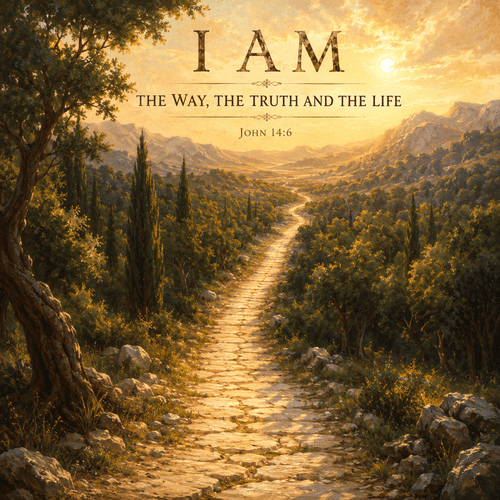
Jesus answers with the most compressed of all 8 declarations: “I am the way, and the truth, and the life. No one comes to the Father except through me” (John 14:6). Every other “I am” statement names one thing Jesus is. This one names three at once, joined so tightly in the Greek they function as a single claim rather than a menu of separate offers.
The next day, the claim would be validated in a way none of the disciples in the room expected. As Jesus died, the curtain that had barred every ordinary Israelite from God’s own presence for a 1000 years tore in 2—not from the bottom, where a person might reach, but from the top (Mark 15:38), where only God could have torn it. The way to God was now open. And it opened at the precise moment Jesus died.
I AM THE WAY, THE TRUTH, AND THE LIFE, AT A GLANCE
Reference: John 14:6. Validating sign: the temple curtain torn in two at His death (Luke 23:45; Matthew 27:51; Mark 15:38). Old Testament root: Isaiah’s call to “prepare the way of the Lord” (Isaiah 40:3). Core claim: Jesus isn’t one route among several to God, one true idea among many, or one source of vitality among others—He is the sole means of access, the standard of truth, and the substance of life itself. “No one comes to the Father except through me.”
This post is Part 7 of a series on Jesus’ eight “I am” statements. Start with the series introduction for the full roadmap.
What Happened at the Moment of His Death
Unlike the healings earlier in this series, the sign behind this claim isn’t something Jesus does for someone else. It’s what happens at the very moment His own life ends—several convergent signs, witnessed and recorded independently, all pointing the same direction.
| SIGN | REFERENCE | SIGNIFICANCE |
|---|---|---|
| The curtain torn | Matthew 27:51; Mark 15:38; Luke 23:45 | The temple curtain, separating the Holy of Holies from everyone but the high priest, tears “from top to bottom”—a direction indicating it was torn by God, not by human hands |
| The earth shakes | Matthew 27:51 | Creation itself responds to the death of the one who made it |
| Tombs open | Matthew 27:52–53 | A preview, at the moment of His death, of the resurrection life He had already claimed to be (John 11:25) |
| The centurion’s confession | Matthew 27:54; Mark 15:39 | A Roman soldier, watching everything unfold, declares, “Truly this was the Son of God” |
| The New Testament’s own commentary | Hebrews 10:19–20 | “A new and living way” opened “through the curtain, that is, through his flesh”—the torn veil directly identified as the way Jesus claimed to be |
Hebrews doesn’t leave the connection for readers to guess at. It states outright the torn curtain and “the way” are the same reality, seen from two different moments—one a claim spoken in an upper room, the other its proof torn open the next afternoon.
A Curtain, a Priest, and a Way Opened
For over a 1000 years, the veil in the tabernacle and then the temple marked the most serious boundary in Israel’s religious life. Only the high priest could pass it, only once a year, only with blood, and only at real personal risk—Israel’s own law warned him not to enter carelessly, “lest he die” (Leviticus 16:2).
| THE TEMPLE VEIL (EXODUS 26; LEVITICUS 16) | THE WAY, THE TRUTH, AND THE LIFE (JOHN 14; HEBREWS 10) | |
|---|---|---|
| Source | A curtain woven by human hands, separating the Holy of Holies from everyone else (Exodus 26:31–33) | Jesus’ own body—“the way he opened for us through the curtain, that is, through his flesh” (Hebrews 10:20) |
| Access | Only the high priest, once a year, with blood, and only in fear (Hebrews 9:7) | “Let us then with confidence draw near to the throne of grace” (Hebrews 4:16)—open and continual for all who come through Him |
| Function | Marked a boundary no ordinary person could cross without dying (Leviticus 16:2) | “No one comes to the Father except through me” (John 14:6)—the boundary is now a person, who invites rather than excludes |
| Outcome | Stood intact for centuries, a permanent reminder of separation | Torn “from top to bottom” the instant Jesus died—separation ended, completely and at once |
The veil had done its job faithfully for centuries: it kept an honest distance between a holy God and an unholy people. What tore it open wasn’t a change in the rules but a person who could finally close the distance Himself.
I Am the Way, the Truth, and the Life (John 14:6)
The 3 nouns aren’t 3 separate options. In the Greek, one definite article governs all 3—“the way, and the truth, and the life” describes a single, unified identity rather than a set of alternatives to pick between. Jesus is the way because He is the truth and the life; the three aren’t stacked side by side but folded into one claim.
Philip’s response, only 2 verses later, shows exactly what’s at stake. “Lord, show us the Father, and it’s enough for us” (John 14:8). Jesus’ reply carries real weight: “Have I been with you so long, and you still do not know me, Philip? Whoever has seen me has seen the Father” (John 14:9). Philip is still looking for the way to God as something separate from the person standing in front of him. Jesus is telling him there’s no such separation left to look for.
ONE CLAIM, NOT THREE
It’s tempting to read “the way, the truth, and the life” as 3 different benefits to choose from—guidance, correct doctrine, vitality. The Greek grammar resists that reading. A single article governs all 3 nouns, binding them into one identity. Jesus isn’t offering a way, a truth, and a life as separate goods. He’s claiming to be, in one indivisible person, everything a person needs to reach God at all.
Older Roots: “The Way” as a Sign of God’s Own Path
Isaiah’s call to prepare the way of the Lord is the most direct Old Testament background to this claim, but “way” and “truth” language runs throughout Israel’s Scriptures as a description of God’s own character and how His people were meant to walk.
| PASSAGE | WHAT HAPPENS | CONNECTION TO JOHN 14 |
|---|---|---|
| Exodus 33:13 | Moses asks God, “please show me now your ways, that I may know you” | “The way” already tied to genuinely knowing God, not merely following instructions |
| Psalm 25:4–5 | “Make me to know your ways, O Lord; teach me your paths… lead me in your truth” | Way and truth already paired together in Israel’s own worship, centuries before John 14 |
| Proverbs 8:22–31 | Wisdom, personified, describes being present with God “at the beginning of his work” | An early Old Testament picture of a divine way and truth that precedes and orders creation itself |
| Jeremiah 6:16 | “Ask for the ancient paths, where the good way is, and walk in it”—a way Israel refused | Shows the tragedy of a way offered and rejected, the same choice now placed before Jesus’ own hearers |
| Isaiah 40:3 | “In the wilderness prepare the way of the Lord” | The direct Old Testament root, quoted by all four Gospels of John the Baptist preparing for Jesus’ arrival |
Every one of these passages treats “the way” as something to seek, ask for, or prepare—always slightly out of reach, always described from a distance. John 14:6 closes the distance by naming the way as a person who has arrived and is standing in the room.
What This Means for the Church
The claim rules out treating Christianity as one spiritual option among many equally valid ones, while also ruling out a faith reduced to correct information. Jesus doesn’t say “I will teach you the way” or “I will show you the truth.” He says He is these things, which means following Him isn’t primarily about mastering a system but about staying close to a person.
That has a practical edge Jesus states in the very next verse: “If you love me, you will keep my commandments” (John 14:15). Being in the way through Him isn’t opposed to obedience—it’s what obedience is actually for. A church that treats “I am the way” as settling the matter of belief while ignoring how its people actually live has kept only half the claim.
Tough Questions, Honest Answers
Isn’t “no one comes to the Father except through me” exclusivist and intolerant in a world of many sincere beliefs?
The claim is narrow, and it’s worth being honest about that rather than softening it. But narrowness isn’t the same as arrogance—any true statement about the only cure for a specific disease, or the only bridge across a specific canyon, will sound exclusive without being unkind. The real question is whether the claim is true, not whether it sounds comfortable. And the same passage that makes this claim opens with Jesus comforting troubled hearts (John 14:1) and elsewhere invites “whoever” will come (John 3:16)—exclusivity of means paired with a wide-open invitation, not narrowness of welcome.
Did the early church actually take up “the Way” as a name for itself?
Yes. Before the term “Christian” became common usage (Acts 11:26), the book of Acts repeatedly calls the movement simply “the Way” (Acts 9:2; 19:9, 23; 24:14). The earliest believers appear to have taken Jesus’ self-designation in John 14:6 as their own defining identity, not merely a doctrine they held but the name they answered to.
Doesn’t “I am the truth” go too far—can’t other religions and philosophies contain real, partial truths?
Scripture doesn’t deny that people outside the church can perceive real things about God and the world; Paul quotes pagan poets approvingly in Athens (Acts 17:28) and argues that God’s existence is evident to everyone through creation (Romans 1:19–20). What John 14:6 claims isn’t that every other system is entirely false, but that Jesus is the standard by which any partial truth is measured, and the only one who embodies truth completely, in a person, rather than merely gesturing toward it.
How does the temple curtain tearing (Luke 23:45) actually connect to “I am the way”? Wasn’t that curtain only about priestly access, not a general claim about salvation?
The New Testament itself draws the connection explicitly, rather than leaving it to later readers to infer. Hebrews 10:19–20 states that believers now have “confidence to enter the holy places… by the new and living way that he opened for us through the curtain, that is, through his flesh.” The curtain’s original function—controlling priestly access to God—is precisely why its tearing is the fitting sign for a claim about access to the Father being thrown open.
Is “I am the life” here the same claim as “I am the resurrection and the life” in John 11:25, or something different?
They’re complementary rather than repetitive. John 11:25 concerns victory over death specifically—resurrection as the answer to the grave. John 14:6 concerns the destination itself—the relational life with the Father that a person is walking toward through Christ, of which resurrection is one part. One claim answers “what happens to death?”; the other answers “what am I actually walking toward?”
Why does Jesus seem almost frustrated with Philip’s request to “show us the Father” (John 14:8–9), right after making this declaration?
It reads less as irritation at ignorance than as grief that, after 3 years together, Philip is still looking elsewhere for something Jesus has been showing him all along. “Whoever has seen me has seen the Father” (14:9) isn’t a rebuke aimed at silencing the question—it’s the answer to it. Philip already had what he was asking for; he simply hadn’t recognised it in the person in front of him.
If “the way” is a person and not a set of rules, does that mean obedience and ethics don’t really matter for a Christian?
No—Jesus draws the opposite conclusion Himself, in the very next breath: “If you love me, you will keep my commandments” (John 14:15). Being in the way through faith in Christ doesn’t replace obedience with indifference; it grounds obedience in relationship rather than in earning a separate path to God. Keeping His commandments isn’t an alternative route alongside Him—it’s what walking with Him actually looks like.
Continue the Series
THIS IS PART 7 OF 9
Jesus makes eight “I am” declarations in Scripture, each validated by a sign and rooted in the Old Testament. Read the series introduction for the full roadmap, including the Bread of Life, the Light of the World, the Door, the Good Shepherd, the Resurrection and the Life, the True Vine, and the Alpha and Omega.
Related Reads
- Jesus’ ‘I AM’ Statements: Proclamations of Deity (Series Introduction)
- I Am the Bread of Life: Why Some Followers Walked Away (John 6:35)
- I Am the Light of the World: Sight Given, Sight Refused (John 8:12)
- I Am the Door: The Only Way Into the Fold (John 10:7)
- I Am the Good Shepherd: A Death Freely Chosen (John 10:11)
- I Am the Resurrection and the Life: Four Days Too Late? (John 11:25)
- I Am the True Vine: What Israel’s Golden Vine Could Not Be (John 15:1)
- I Am the Alpha and the Omega: Every Story’s Beginning and End (Revelation 1:8)