Anyone who had walked through the temple that week would have seen it: a massive golden vine, spread above the sanctuary entrance, with grape clusters some said were as tall as a man. Ancient historian Josephus describes it as one of the temple’s most striking features—a national symbol so treasured that wealthy worshippers could donate gold to add another cluster to it. The vine had represented Israel for centuries, ever since the prophets first pictured the nation as a vineyard planted and tended by God Himself.
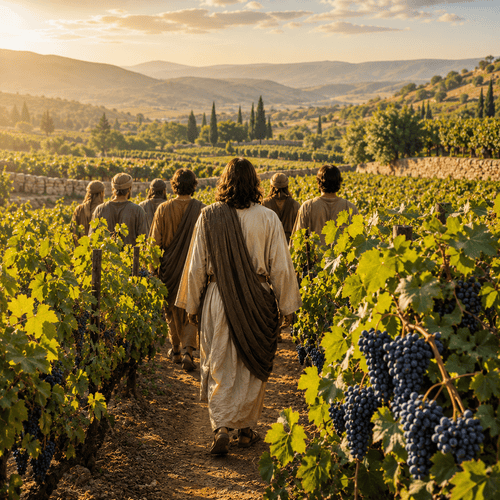
It is against that backdrop, on the night before His death, that Jesus turns to His disciples and says, “I am the true vine, and my Father is the vinedresser” (John 15:1). Not a vine. The true vine—as though every other claimant to the title, golden temple decoration included, were a copy of something only He actually is.
The claim was not new to that night. Three years earlier, at the very start of His public ministry, Jesus had already given the disciples a first glimpse of what abundance flowing from Him would look like—at a wedding, with ordinary water and more wine than any celebration required.
I AM THE TRUE VINE, AT A GLANCE
Reference: John 15:1. Validating sign: water turned to wine at Cana (John 2:1–12), the first of Jesus’ signs. Old Testament root: Israel pictured as God’s vineyard, planted with every advantage and expected to bear fruit (Isaiah 5:1–7; Psalm 80:8–16). Core claim: Jesus is not one more branch grafted into Israel’s story but the vine itself—the genuine source His people were always meant to draw life from. “Apart from me you can do nothing” (John 15:5).
This post is Part 8 of a series on Jesus’ eight “I am” statements. Start with the series introduction for the full roadmap.
The Sign That Validates the Claim
The sign behind this claim comes from the opposite end of Jesus’ ministry from where the declaration is made—not because the connection is weak, but because John seems to have built it in deliberately. His Gospel opens with wine in abundance and closes its public teaching with a vine that promises exactly that kind of abundance again.
| STAGE | JOHN 2 REFERENCE | WHAT HAPPENS |
|---|---|---|
| The setting | 2:1–2 | A wedding at Cana in Galilee; Jesus, His mother, and His disciples are among the guests |
| The shortage | 2:3–5 | The wine runs out; Mary tells the servants simply, “Do whatever he tells you” |
| The instruction | 2:6–8 | Jesus has six stone jars, kept for Jewish purification rites, filled with water and taken to the master of the feast |
| The transformation | 2:9–10 | The water has become wine—and remarkably better wine than what was served first |
| John’s verdict | 2:11 | “This, the first of his signs, Jesus did… and manifested his glory. And his disciples believed in him” |
The best wine, saved for last, was already a quiet preview of the claim to come: real abundance, of a kind the old system could not produce, flowing from Jesus alone. Three years later, He names exactly where that abundance comes from.
A Vine Israel Was Meant to Be
Israel’s prophets had used vineyard imagery for the nation long before that golden vine was ever hung over the temple door. The most famous instance is a song, sung in Isaiah’s own voice, about a vineyard given every advantage and still producing nothing worth eating.
| ISRAEL, GOD’S VINEYARD (ISAIAH 5; PSALM 80) | THE TRUE VINE (JOHN 15) | |
|---|---|---|
| Planting | A vine planted and cared for by God, given every advantage (Isaiah 5:1–2) | Jesus Himself is “the true vine,” with the Father as “the vinedresser” (John 15:1) |
| Expectation | God “looked for it to yield grapes, but it yielded wild grapes” (Isaiah 5:2, 4) | “Abide in me, and I in you… he it is that bears much fruit” (John 15:4–5)—fruit now flows from abiding union, not mere planting |
| Failure | The vineyard is given over to ruin, its wall broken down (Isaiah 5:5–6) | “Every branch in me that does not bear fruit he takes away” (John 15:2)—the same warning, now applied to branches in Christ rather than a nation |
| Outcome | National judgement for persistent unfruitfulness (Isaiah 5:7) | “If you abide in me, and my words abide in you, ask whatever you wish, and it will be done for you” (John 15:7)—fruitfulness restored as a real possibility |
Isaiah’s song ends in judgement, not resolution—the vineyard is left as wasteland, its fate a warning left hanging over the rest of Israel’s story. John 15 is Jesus stepping into that unresolved song and offering, for the first time, a vine that can actually keep its promise.
I Am the True Vine (John 15:1, 5)
“True” here does not simply mean truthful, in the sense of not lying. It means genuine, the real article, as opposed to every representation—including a golden temple ornament—that could only gesture toward what Israel was meant to be. Jesus is claiming to be the substance the nation’s own most cherished symbol had only ever pictured.
The verb that carries the whole passage is “abide,” repeated more than ten times in this chapter alone. “I am the vine; you are the branches. Whoever abides in me and I in him, he it is that bears much fruit, for apart from me you can do nothing” (John 15:5). Abiding is not a one-time decision remembered later. It is an ongoing, moment-by-moment dependence, the branch drawing continually on a life it did not generate itself.
WHY DOES A FRUITFUL BRANCH GET PRUNED TOO?
“Every branch that does bear fruit he prunes, that it may bear more fruit” (John 15:2). Pruning in this passage is not a punishment for failure—it is what a good vinedresser does specifically to branches that are already fruitful, cutting back what is unnecessary so more of the vine’s strength reaches what matters. Discipline in the Christian life works the same way: “the Lord disciplines the one he loves” (Hebrews 12:6), not to punish good fruit but to produce more of it.
Older Roots: The Vine as a Sign of Israel’s Calling
Isaiah’s vineyard song is the most famous Old Testament background to this claim, but vine imagery for God’s people runs from the patriarchs to the exile.
| PASSAGE | WHAT HAPPENS | CONNECTION TO JOHN 15 |
|---|---|---|
| Genesis 49:11–12 | Jacob’s blessing pictures the coming ruler from Judah tying his donkey to the vine, his garments washed in wine | Vine and abundance imagery tied to the promised ruler from the earliest patriarchal blessings |
| Psalm 80:8–16 | “You brought a vine out of Egypt… the vine which your right hand planted”—now broken down and burned, its restoration prayed for | The exodus generation pictured as God’s vine, with a plea for the very restoration Jesus offers |
| Isaiah 5:1–7 | The Song of the Vineyard: planted with every advantage, it yields only wild grapes | The direct Old Testament root behind “the true vine” (see above) |
| Jeremiah 2:21 | “I planted you a choice vine, wholly of pure seed. How then have you turned degenerate?” | God’s own bewilderment at Israel’s unfruitfulness, despite the finest possible planting |
| Ezekiel 19:10–14 | Israel pictured as a vine transplanted by abundant water, fruitful for a time, then uprooted and burned | A warning of judgement that John 15’s pruning language deliberately echoes and answers |
Every one of these passages ends the same way the golden temple vine silently admitted: real fruitfulness was promised, and real fruitfulness never quite arrived. John 15 is the first time in the whole story that the vine itself, not merely its gardener, takes responsibility for making sure the fruit actually comes.
What This Means for the Church
The claim relocates the source of a fruitful life away from effort and toward abiding. A Christian does not manufacture spiritual fruit by trying harder at goodness in isolation from Christ, any more than a branch produces grapes by straining against the vine it is cut off from. “Apart from me you can do nothing” is not a discouragement. It is a relief—fruit was never supposed to be self-generated in the first place.
It also reframes what pruning and hardship mean inside a life that is genuinely fruitful. Cutting back is not evidence that something has gone wrong. In a well-tended vineyard, it is often the clearest evidence that something is going right.
Tough Questions, Honest Answers
Does “every branch that does not bear fruit he takes away” (John 15:2) mean a genuine believer can lose salvation through underperformance?
The Greek verb translated “takes away” (airō) can also mean “lifts up,” a meaning some scholars connect to an actual viticultural practice—propping up a drooping, fruitless branch so it can catch light and bear again, rather than cutting it off outright. Whichever nuance is primary here, the passage’s pastoral weight falls on warning against false, fruitless profession rather than a formula for losing genuine salvation by falling short of some fruit quota. John elsewhere describes people who abandon the faith as those who “went out from us, because they were not of us” (1 John 2:19)—a description of never having truly abided, not of abiding and then being cut off for insufficient output.
Is the detail about a golden vine on the Jerusalem temple historically accurate, or just a nice illustration?
It is a well-attested detail, recorded by the first-century historian Josephus and referenced in later rabbinic sources, describing a large golden vine over the temple’s sanctuary entrance that worshippers could add gold clusters to as an offering. Whether Jesus specifically gestured toward it while speaking is not something the Gospel text itself claims either way—but the vine’s standing as a widely recognised national and religious symbol makes the contrast with “I am the true vine” a natural one regardless of the exact staging.
Why does the validating sign for this claim come from so early in Jesus’ ministry, rather than something closer to when the declaration is actually made?
It appears to be a deliberate frame around His whole public ministry. The first sign in John’s Gospel involves wine in abundance at a wedding; the last extended teaching before the arrest involves a vine promising abundant fruit. The “good wine… kept… until now” at Cana (John 2:10) previews exactly the kind of overflow John 15 later promises to everyone who abides.
What does “abide” actually mean in practice—is it just another word for believing?
It describes something ongoing rather than a completed transaction. Initial faith is the branch being grafted in; abiding is the continual dependence that follows—prayer, obedience, and remaining in relationship, not a decision made once and set aside. Jesus ties abiding directly to obedience two verses later: “If you keep my commandments, you will abide in my love” (John 15:10).
Does the vine-and-branches picture contradict Paul’s image of the body of Christ, or Peter’s image of living stones—why does the New Testament use so many different metaphors for the church?
They are complementary, not competing. The vine highlights organic dependence and fruitfulness; the body highlights diverse function held together in unity (1 Corinthians 12); living stones highlight a corporate structure being built into a dwelling place for God (1 Peter 2:5). No single picture captures every dimension of what it means to belong to Christ together, so Scripture layers several, each one true from its own angle.
Given that some Christian traditions treat alcohol as spiritually dangerous, is wine itself significant in this passage?
John 15 itself never mentions wine—it speaks of a vine and fruit, meaning grapes, not a finished drink. The connecting sign is the Cana miracle, but the True Vine discourse is about spiritual fruitfulness and character, not a statement about alcohol one way or the other. The Old Testament vine imagery behind it is likewise about a nation’s covenant faithfulness, not a beverage.
“Apart from me you can do nothing” (John 15:5) sounds absolute—does this mean people who don’t follow Christ can’t do any good or accomplish anything meaningful?
The context restricts the claim to a specific kind of fruit: lasting, Spirit-produced fruit that flows from abiding union with Christ, described two verses later as “fruit that will last” (John 15:16). It is not a denial that unbelievers can act kindly, build good things, or love their families well in ordinary human terms—Jesus elsewhere affirms that God “makes his sun rise on the evil and on the good” (Matthew 5:45). The “nothing” in view is the specific, eternal fruit this passage is about, not every form of human accomplishment.
Continue the Series
THIS IS PART 8 OF 9
Jesus makes eight “I am” declarations in Scripture, each validated by a sign and rooted in the Old Testament. Read the series introduction for the full roadmap, including the Bread of Life, the Light of the World, the Door, the Good Shepherd, the Resurrection and the Life, the Way the Truth and the Life, and the Alpha and Omega.
Related Reads
- Jesus’ ‘I AM’ Statements: Proclamations of Deity (Series Introduction)
- I Am the Bread of Life: Why Some Followers Walked Away (John 6:35)
- I Am the Light of the World: Sight Given, Sight Refused (John 8:12)
- I Am the Door: The Only Way Into the Fold (John 10:7)
- I Am the Good Shepherd: A Death Freely Chosen (John 10:11)
- I Am the Resurrection and the Life: Four Days Too Late? (John 11:25)
- I Am the Way, the Truth, and the Life: One Claim, Not Three (John 14:6)
- I Am the Alpha and the Omega: Every Story’s Beginning and End (Revelation 1:8)