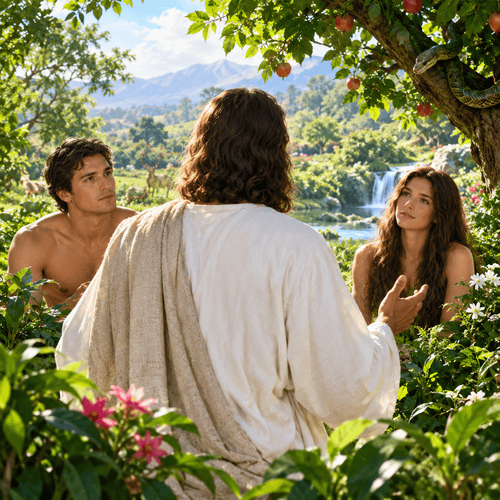
God preached the first sermon in history to a snake.
Adam and Eve stood nearby. They’d just ruined everything, and they were waiting to hear what God would say to them. But God turned to the serpent instead and announced a promise about a child who hadn’t yet been born:
“I will put enmity between you and the woman, and between your offspring and her offspring; he shall bruise your head, and you shall bruise his heel.” (Genesis 3:15)
For roughly 18 centuries, Christians have called this verse the protoevangelium, a Greek word meaning “the first gospel.” It’s the opening line of the Bible’s great story, and everything that follows can be read as the unfolding of that promise.
But what does Genesis 3:15 really mean? That’s the question this post sets out to explore. It’s the first in our series on where Jesus appears in all 39 books of the Old Testament, and Genesis is where the whole argument begins—and where it must first be tested.
Jesus in the Old Testament — Book 1 of 39
This post is the first instalment in our series tracing Christ through every book of the Old Testament. See the full series index.
First, the case against us
Plenty of careful readers think the protoevangelium is Christians reading their own ending back into somebody else’s beginning. Here’s that case at its strongest.
- It reads like an origin story. Ancient literature is full of short tales explaining why the world is the way it is. On the surface, Genesis 3:15 explains why human beings and snakes hate each other, why snakes strike at ankles, and why people crush snakes’ heads with their feet. Nothing more is required to make sense of it.
- The Hebrew word is usually collective. The word translated “offspring” is zera, literally “seed”. Like the English word “offspring”, it normally refers to descendants as a group, not one individual. Reading a single person out of it looks like special pleading.
- The two blows are described with the same verb. The same Hebrew word is used for what happens to the head and what happens to the heel. If the writer wanted to describe a decisive victory, he had better words available. What he actually wrote sounds like a permanent, mutual struggle—a draw, not a triumph for either side.
- Nobody in Genesis acts as though a Messiah has been promised. No character quotes the verse. No prophet in the rest of the Old Testament cites it. If it’s the foundation of everything, its own book is oddly quiet about it.
We think 3 of those 4 points are answerable and 1 of them is partly right. Here’s the reply, in order.
Why we still read this as a promise of Christ
The wounds aren’t the same wound
The critic is correct about the verb being identical. That’s the point. Genesis deliberately uses one word and then changes the target, so the difference lies entirely in where each blow lands. A strike to the heel hurts badly but heals. A strike to the head ends the fight. The grammar is balanced precisely so the anatomy can be unbalanced.
And this isn’t a reading invented later. Paul tells the church in Rome God will soon crush Satan under their feet (Romans 16:20). He isn’t making a general remark about spiritual warfare; he’s quoting Eden and telling a congregation they’re standing inside the promise.
| THE WORDS GOD SPEAKS | WHAT IT MEANT TO THE FIRST HEARERS | HOW THE REST OF THE BIBLE ANSWERS IT |
|---|---|---|
| “I will put enmity between you and the woman” | The alliance between the woman and the tempter is over. God Himself breaks it. Note who does the breaking—this is an act of mercy, not a punishment. | The war between the kingdom of God and the kingdom of darkness runs through the whole Bible and is God’s doing, not ours. |
| “and between your offspring and her offspring” | The conflict will not be settled in one generation. It will run through the descendants of both sides. | Jesus tells some of His opponents that their father is the devil (John 8:44). Two lines of descent, one physical, one spiritual. |
| “he shall bruise your head” | A head wound is a killing blow. Whoever this is, He wins. | Paul says God will soon crush Satan under the feet of believers (Romans 16:20) — a direct echo of this verse. |
| “and you shall bruise his heel” | A heel wound is real and painful, but survivable. The victory will cost the winner something. | The cross. Jesus wins by being wounded, and the wound does not keep Him. |
Genesis itself narrows the word “seed”
This is the strongest reply to the grammatical objection, and it doesn’t depend on the New Testament at all. We only have to read Genesis to the end.
The book is built around a repeated formula, “these are the generations of…” It appears 10 times and divides the whole book into sections. Genesis is, structurally, a book about a line of descent. And that line keeps getting narrower.
Timeline: how the promise narrows
- In Eden (Genesis 3:15). The promise is given to the whole human race through the woman. No family, no tribe, no name.
- After Cain (Genesis 4:25). Eve names her third son Seth and says God has given her another offspring. 2 lines are now visible—1 that kills, and 1 through which the promise travels.
- After the flood (Genesis 9:26). Noah blesses the God of Shem specifically. Of three sons, the line runs through one.
- With Abraham (Genesis 12:3; 22:18). One man from one city is chosen, and through his offspring all the nations of the earth will be blessed. The line narrows and the scope widens at the same moment.
- Isaac, not Ishmael. Jacob, not Esau. Twice the older son is passed over. Twice God says the promise runs through the younger. This isn’t how inheritance worked; it’s how grace works.
- Judah, not his brothers (Genesis 49:10). In Jacob’s final blessing the promise lands on one tribe, and for the first time it’s explicitly royal: the sceptre will not depart from Judah, and to him shall be the obedience of the peoples.
By the last chapter of the first book of the Bible, a promise made to all humanity has been funnelled down to one tribe and given a crown. That narrowing is the plot of Genesis. A collective noun that keeps being attached to one chosen individual, generation after generation, is a collective noun being pointed at somebody. At somebody down the line.
WHAT “SEED” DOES IN HEBREW—AND WHY IT MATTERS HERE
Zera can mean descendants as a group (“Abraham’s seed” = the Jewish people) or one descendant (“Seth, another seed in place of Abel”, Genesis 4:25). Hebrew leaves it to the context.
2 details are worth knowing.
First, when the Hebrew Scriptures were translated into Greek before the time of Christ, the translators of Genesis 3:15 followed the neuter noun for “seed” with a masculine singular pronoun. That’s grammatically odd, but a strong hint they understood an individual was in view.
Second, Paul builds an entire argument on precisely this singular sense in Galatians 3:16, insisting the promise was made to one offspring, who is Christ.
So the apostolic reading isn’t an innovation. It is a well-worn Jewish way of taking the word, applied to a particular man.
The fourth objection: Why does nobody explain Genesis 3:15?
The critic is partly right: no character in Genesis stands up and explains the verse. No later prophet quotes it.
But look at what the people in Genesis actually do. They watch the births.
When Eve has her first son, she says, “I have gotten a man with the help of the LORD” (Genesis 4:1). That’s an odd thing to say about a newborn. She doesn’t say she has had a child. She says she has received a man, and she gives God credit for it. Something has been promised, and she seems to think it has now arrived. She’s wrong—the boy is Cain, who grows up to commit the first murder—but she’s wrong in a way that only makes sense if she was waiting for someone.
4 chapters later, Lamech names his son Noah and says he hopes this child will bring relief from the ground God has cursed (Genesis 5:29). Wrong again, and wrong in the same direction. These parents aren’t reciting a doctrine. They’re hoping out loud this baby is the one.
Geerhardus Vos described God’s revelation as growing the way a seed grows into a tree. That’s exactly what is happening here. The people in Genesis are living in Chapter 3 of a very long book. They can’t see the ending, because it hasn’t been written yet. What they have is a promise, a curse, and a slowly hardening sense that a son is coming.
He was already there in verse one
We’ve started where most people start, with the promise in Chapter 3. But Genesis opens with God speaking. “And God said, ‘Let there be light,’ and there was light.” Creation happens by word. Nothing is wrestled into shape or fought for. God speaks, and reality obeys.
Centuries later, John opens his Gospel by deliberately copying Genesis word for word—”In the beginning”—and then tells us who was speaking:
“All things were made through Him, and without Him was not any thing made that was made.” (John 1:3)
John is not adding a character to Genesis 1. He is naming one who was there all along. Paul says the same thing to the Colossians: everything in heaven and on earth was created through Christ and for Christ, and it is held together in Him right now (Colossians 1:16–17). The writer of Hebrews says God made the world through His Son, who upholds the universe by the word of His power (Hebrews 1:2–3).
Put those verses together and something crucial follows. The hands that shaped Adam out of dust are the hands that were later nailed to a cross. The voice that called light out of nothing is the voice that called Lazarus out of a tomb. This isn’t a poetic comparison. It’s a claim about the same person doing both jobs.
Why this matters for everything that follows
Once you see that the Creator and the Redeemer are the same person, the shape of Genesis changes. Redemption stops looking like an emergency repair carried out by a different department. The one who made the world is the one who comes back for it.
Watch how many roles He turns out to hold:
| WHAT HE DOES | WHERE YOU SEE IT IN GENESIS | WHERE YOU SEE IT IN CHRIST |
|---|---|---|
| Creator—He makes what exists, by word | God speaks and the world appears (Genesis 1) | All things made through Him (John 1:3; Colossians 1:16) |
| Seeker—He comes looking for the guilty | God walks in the garden and asks, “Where are you?” (Genesis 3:8–9) | The Son of Man comes to seek and save the lost (Luke 19:10) |
| Priest—He covers shame at a cost | God clothes Adam and Eve in garments of skin (Genesis 3:21) | A great high priest who clothes us in His own righteousness (Hebrews 4:14) |
| Provider of the sacrifice | “God will provide for himself the lamb” (Genesis 22:8) | Behold, the Lamb of God (John 1:29) |
| Judge—He will finally settle every account | “Shall not the Judge of all the earth do what is just?” (Genesis 18:25) | The Father has given all judgement to the Son (John 5:22) |
Note the first question God asks in the Bible. It’s not an accusation. It is “Where are you?”—asked by the one who already knew, to two people hiding in the bushes of a world He had made a few days earlier.
Meredith Kline argued the Spirit hovering over the waters in Genesis 1:2 is the same divine presence that fills the tabernacle and finally rests on Christ at His baptism. Whether or not you follow every step of that argument, the instinct behind it is right: Genesis 1 isn’t a separate story from the Gospels. It’s Page 1 of the same one.
Christ elsewhere in Genesis
Our series works with four ways Jesus appears in the Old Testament: promise, pattern, presence and purpose. Genesis is unusual in containing all four in strength.
- Promise. Genesis 3:15, the blessing of the nations through Abraham’s offspring (12:3; 22:18), and the royal promise to Judah (49:10).
- Presence. Several passages in Genesis describe a figure who speaks as God, is addressed as God, and is yet spoken of as sent. The angel of the LORD finds Hagar in the desert, and she names God as the one who sees her (16:7–13). A man wrestles Jacob all night, and Jacob says afterwards that he has seen God face to face (32:24–30). At the end of his life Jacob blesses his grandsons in the name of “the angel who has redeemed me from all evil” (48:16), placing this figure alongside God in a single blessing.
- Purpose. The covenant thread begins here—with Noah, and then with Abraham in a ceremony where God alone walks between the pieces of the sacrifice (15:17), taking the whole obligation on Himself.
- Pattern. This is the largest category in Genesis, and the one that needs the most care. The table below sets out the main candidates and, crucially, how confident we think anyone should be about each.
| WHAT OR WHO | WHAT ACTUALLY HAPPENS IN GENESIS | HOW THE NEW TESTAMENT HANDLES IT | HOW SURE CAN WE BE? |
|---|---|---|---|
| Adam | One man’s single act changes the standing of everyone who comes after him. | Paul calls Adam a pattern of the one who was to come, and calls Jesus the last Adam. | Stated in the New Testament |
| Noah’s ark | One door. Judgement falls outside it; everyone inside comes through alive. | Peter connects the waters of the flood to baptism and to being saved through judgement. | Stated in the New Testament |
| Melchizedek | A priest and a king at once, with no recorded father, mother or death. | Hebrews argues at length that Christ is a priest of his order rather than Aaron’s. | Stated in the New Testament |
| Isaac on Mount Moriah | The beloved only son carries the wood up the hill and is, in his father’s mind, already dead. | Hebrews says Abraham received him back as a figure of resurrection. | Stated in the New Testament |
| The ram in the thicket | A substitute dies so the son walks down the mountain alive. Abraham had said God would provide the lamb. | John the Baptist points at Jesus and calls Him the Lamb of God who takes away the sin of the world. | Strongly implied |
| Jacob’s ladder | A stairway joining earth to heaven, with God at the top, given to a man running away from his sin. | Jesus tells Nathanael that angels will ascend and descend on the Son of Man. | Stated in the New Testament |
| Joseph | Rejected by his brothers, sold for silver, unjustly condemned, raised to the right hand of the throne, and the saviour of the people who betrayed him. | No New Testament writer calls Joseph a type outright, but Joseph himself names the pattern in Genesis 50:20. | A likely pattern |
| The garments of skin | God covers the shame of the guilty, and something dies so that the covering exists. | No New Testament passage makes the link explicitly, though the logic of covering and cost runs through Scripture. | Suggestive only |
Read the last column before the others. Edmund Clowney warned preachers against two opposite mistakes: missing Christ where Genesis really does point to Him, and inventing Him where it does not. The only protection against the second mistake is being willing to write “suggestive only” in public.
WHERE WE STOP SHORT
Some popular readings of Genesis go further than we’re willing to go, and it’s worth naming them:
- That the three decks of the ark represent the Trinity. The text gives no hint of this, and the number is structural, not symbolic.
- That the wood Isaac carried is the cross because both are wood. The link between Isaac and Christ is real, but it rests on the father, the only son and the substitute—not on the material.
- That the coat of many colours stands for something. Genesis tells us what it stood for: Jacob’s favouritism, and the reason the brothers hated Joseph.
The test we apply is simple. Is this the point the passage is making, or a detail we have decorated? John Calvin’s complaint has aged well: that readers who chase hidden meanings end up making Scripture mean whatever they like.
Why this changes how we read Genesis
Genesis is often treated as the book of beginnings. That’s a true reading, but it’s incomplete. It’s also the book of the promise that survives everything thrown at it. A murder in Chapter 4. A flood in Chapter 7. A barren womb, twice. A famine. A family so dysfunctional its own members sell a brother into slavery.
And the promise doesn’t die. It gets narrower, more specific and harder to kill with every chapter, until it ends up in Egypt, in a coffin, waiting (Genesis 50:26)—an ending that’s really a held breath.
Herman Bavinck argued grace doesn’t abolish nature but restores it, and Genesis is the first evidence for that claim. What God promised in Eden isn’t a plan B. It is the plan, announced to an enemy, carried through a flawed family, and finally kept by a man who let His heel be struck so that He could crush the serpent’s head.
Next in this series: Jesus in Exodus, where the promise acquires a lamb.
Tough Questions, Honest Answers
Was Melchizedek an appearance of Jesus Himself?
Some have thought so, because Hebrews describes him as being without father, mother or genealogy, and resembling the Son of God. But that is the more likely clue that he was not. Hebrews says he resembles the Son — a comparison only makes sense between two different people. The phrase about no genealogy almost certainly means that Genesis records none, which is striking in a book obsessed with family lines, and that silence is what makes him useful as a picture of a priesthood that does not depend on ancestry. Our view is that he was a real Canaanite priest-king whom God placed in the story deliberately.
Does this reading depend on Genesis 1–11 being literal history?
It depends on Adam being a real person, yes. Paul’s whole argument in Romans 5 works by comparing two individuals whose single actions had consequences for everyone connected to them. If the first man is a symbol, the second man’s work becomes very hard to explain in the terms the New Testament actually uses. Genesis 3:15 is a promise made to actual people after an actual rebellion, and the seriousness of the rescue depends on the reality of the ruin.
If Jesus is “her offspring”, does that give Mary a special place?
It gives her an honoured place, not a saving one. The phrase “her offspring” is unusual, since Hebrew genealogies normally run through fathers, and it is reasonable to see a quiet hint of a birth in which no human father is involved. Some translations have historically rendered the verse as “she shall crush your head”, which shifts the victory to the woman; that reading rests on a Latin rendering rather than the Hebrew, where the pronoun refers to the offspring. Mary is blessed among women because of who her son is. The head-crusher in Genesis 3:15 is Him.
Does Genesis 22 make God look like a deity who wants child sacrifice?
It looks that way until the end of the chapter, which is exactly how the story is designed to work. The command is a test, God stops it before it happens, and the scene ends with a substitute dying instead of the son. Everywhere else in Scripture God condemns child sacrifice in the strongest terms. The point of Moriah is not that God wants sons killed; it is that God provides the offering Himself, which is what Abraham says before he even reaches the top of the hill. Read as a whole, the chapter is the strongest anti-child-sacrifice text in the ancient world.
Did God kill an animal in Genesis 3:21 to teach the first sacrifice?
The text says God made garments of skin and clothed them, and it does not say more. An animal presumably died; the passage does not comment on it, and no later writer builds on it. We think the honest position is that the scene teaches something real — God Himself covers the shame of the guilty, and the covering He provides is better than the one they made — without claiming that Genesis is instituting a sacrificial system here. This is a case where preachers often state as certain something the text leaves open.
Where is the Holy Spirit in Genesis?
He is in the second verse. The Spirit of God hovers over the waters before anything is made, which is the first thing the Bible tells us God is doing. He appears again as the giver and sustainer of life (Genesis 6:3) and as the one who equips Joseph with wisdom that Pharaoh himself recognises (Genesis 41:38). Genesis does not give us a developed doctrine of the Trinity, and we should not pretend it does. What it gives us is the raw material: God speaking, God’s Spirit moving, and a word that accomplishes what it says.
Why does Genesis show its heroes behaving so badly?
Because it is not written to give us heroes. Abraham lies about his wife twice. Jacob is a deceiver. Judah, the tribe that receives the royal promise, is introduced doing something disgraceful. If the book were propaganda for a nation, this is not how you would write it. The honesty is part of the argument: the promise is not carried by the quality of the people, or it would have failed in chapter four. Genesis is a book about a faithful God and an unreliable family, and the ratio never changes.
Related Reads
- Jesus in the Old Testament: Where He Appears In All 39 Books
- Is Jesus in the Book of Ruth? Boaz as Kinsman Redeemer
- The Bronze Serpent and the Cross: Seeing Jesus in Numbers 21
- The Rock Moses Struck: Finding Jesus in Exodus 17
- Wisdom Personified: The Compelling View of Jesus in Proverbs 8
- The Divine Romance: Finding Jesus in the Song of Solomon
- Jesus in the Jewish Festivals: From Shadow to Substance