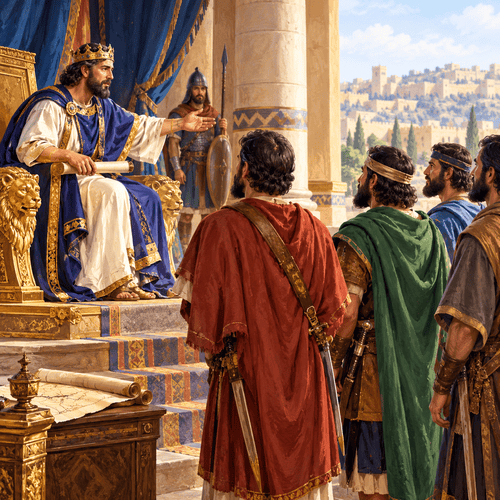
Here is a Bible puzzle that sceptics love to throw at Christians. 2 verses describe the very same event. One says God did it. The other says Satan did it. Surely both can’t be true?
2 Samuel 24:1 says the LORD moved King David to count his people. 1 Chronicles 21:1 says Satan did. Same king. Same count. 2 very different names.
Many websites call this one of the clearest contradictions in the Bible. But these 2 verses don’t fight each other. They work together like the 2 lenses in a pair of glasses. Look through both, and the picture becomes sharp—and it shows us how God rules His world.
By the end of this article, you’ll see the answer isn’t “God or Satan”. It’s “God and Satan—in very different ways, and for very different reasons.”
KEY TERMS AT A GLANCE
- Census: an official count of people. Here, David counted his fighting men.
- The Chronicler: the unnamed writer of 1 and 2 Chronicles. He wrote after the Jews came home from exile in Babylon.
- Providence: God’s ongoing care and control over everything that happens in His world.
The 2 Verses Side by Side
Here are both verses in the English Standard Version (ESV).
Again the anger of the LORD was kindled against Israel, and he incited David against them, saying, “Go, number Israel and Judah.”
2 Samuel 24:1
Then Satan stood against Israel and incited David to number Israel.
1 Chronicles 21:1
Table 1: How the two accounts of David’s census compare
| Detail | 2 SAMUEL 24:1 | 1 CHRONICLES 21:1 |
|---|---|---|
| Who incites David? | The LORD | Satan |
| What’s the background? | God’s anger “was kindled against Israel” | Satan “stood against Israel” |
| When was the book written? | Earlier, during the time of Israel’s kings | Later, after the exile (around 450–400 BC) |
| What is the book’s main focus? | David’s reign, with all its failures | The temple, worship and God’s promises to David’s family |
Notice 2 things. Both chapters describe the same event, often word for word. And in both verses the action is aimed “against Israel”. Keep that in mind.
Is This Really a Contradiction?
A contradiction is when 2 statements can’t both be true in the same sense. “The door is open” and “the door is shut” contradict each other.
But “the builder built the house” and “the owner built the house” don’t. One did the work; the other planned it and paid for it. Both are true. So the real question isn’t whether God or Satan was involved, but how each one was involved.
Clue 1: The Same Hebrew Word
The Old Testament was written mostly in Hebrew. In both verses, the word translated “incited” is the very same Hebrew verb: sût (say it like “soot”). It means to stir up, urge or lure someone into something.
The Chronicler didn’t choose a softer word to protect God’s good name. He used the same word and named another actor who was also at work. The Bible uses this word elsewhere in the same two-sided way:
- In Job: God says to Satan, “you incited me against him to destroy him without reason” (Job 2:3). Satan stirred; God acted. Yet God did no wrong.
- In Ahab’s life: No one did evil like Ahab, “whom Jezebel his wife incited” (1 Kings 21:25). Jezebel pushed him, but Ahab still answered for his own sin.
- In David’s own words: Years earlier, while Saul was hunting him, David said, “If it is the LORD who has stirred you up against me, may he accept an offering” (1 Samuel 26:19). David already believed God can stir a heart without doing wrong Himself.
Clue 2: The Bible Shows This Pattern Again and Again
Theologians have a name for this pattern: concursus. It’s a Latin word that means “running together”. It describes how God’s plan and a creature’s choice run together in one event. God is the first cause—the One whose plan stands behind everything. People and spirits are second causes—they make real choices, and they are fully responsible for them.
Table 2: One event, two causes—the same pattern across the Bible
| EVENT | THE HUMAN OR EVIL AGENT | GOD’S HAND IN IT | BIBLE REFERENCE |
|---|---|---|---|
| Joseph sold as a slave | His brothers “meant evil” | “God meant it for good” | Genesis 50:20 |
| Job loses everything | Satan, raiders and a storm | “The LORD has taken away” | Job 1:21 |
| Assyria invades Israel | Assyria wants only to destroy | Assyria is “the rod of my anger” | Isaiah 10:5–7 |
| Shimei curses David | Shimei’s hatred | “The LORD has said to him, ‘Curse David’” | 2 Samuel 16:10 |
| King Ahab is misled | A lying spirit | “The LORD has put a lying spirit” | 1 Kings 22:23 |
| Jesus is crucified | “Lawless men” | “The definite plan and foreknowledge of God” | Acts 2:23 |
The cross is the clearest case. Herod, Pilate and the crowds gathered against Jesus “to do whatever your hand and your plan had predestined to take place” (Acts 4:28). If God can rule over the worst sin in history without sinning, He can certainly rule over a census.
As Proverbs 21:1 says, “The king’s heart is a stream of water in the hand of the LORD; he turns it wherever he will.”
PICTURE IT: THE AUTHOR AND THE STORY
John Frame, a modern theologian, often compares God to the author of a story. Inside a novel, a villain makes evil choices, and he is truly guilty within the story. Yet every word on the page is there because the author planned it. The author is not the villain.
The picture is not perfect, but it helps: God plans; creatures choose; creatures carry the blame for their sin.
Clue 3: God Does More Than “Allow”
Many articles say God simply “permitted” Satan to tempt David. That doesn’t go far enough. In 2 Samuel 24:1, God is not watching from the side. He is the subject of the verb. He incited David.
The Westminster Confession of Faith (1646), a great summary of Bible teaching from the Reformation era, puts it carefully. God rules over sin “not by a bare permission”. His rule includes “a most wise and powerful bounding, and otherwise ordering, and governing” of it. Yet “the sinfulness thereof proceedeth only from the creature, and not from God” (chapter 5, paragraph 4).
In plain English: God doesn’t just let evil happen. He sets its limits, steers it, even uses it for His holy goals. But the evil belongs to the sinner, never to God.
John Calvin, the French Reformer, saw the weakness of the “permission” idea nearly 500 years ago. In his Institutes of the Christian Religion (Book 1, chapter 18), he said people fall back on the difference between “doing and permitting” because they cannot grasp how God “directs their malice to whatever end he pleases”. The Bible says more than “allow”, and so should we.
19th-century scholar Carl Friedrich Keil explained our verses the same way: God’s anger was the deeper cause; Satan was the tool. Herman Bavinck, the great Dutch theologian, taught that sin never falls outside God’s plan, or God would not truly be Lord of His world.
WHY THIS MATTERS
RC Sproul often warned, “If there’s one single molecule in this universe running around loose, totally free of God’s sovereignty…” then we could not trust a single one of God’s promises.
A God who only watches Satan from the side cannot promise that “all things work together for good” (Romans 8:28). A God who rules even over Satan can.
1 Act, 3 Hearts
So who incited David? The best answer is that three persons were at work in the same act—each with a very different heart.
Table 3: Three persons, one act, three different goals
| WHO? | WHAT DID THEY DO? | WHY? (THEIR GOAL) | GOOD OR EVIL? |
|---|---|---|---|
| God | Ordained the census as an act of judgement (2 Samuel 24:1) | To judge Israel’s sin and, in the end, to show mercy | Holy and just |
| Satan | Tempted David to take the census (1 Chronicles 21:1) | To harm and destroy God’s people | Evil |
| David | Gave the order and ignored Joab’s warning (2 Samuel 24:2–4) | Pride and trust in the size of his army | Sinful—“I have sinned greatly” (2 Samuel 24:10) |
This is the key to the puzzle. One action can have several causes, and each is judged by its own goal. Satan wanted ruin. David wanted glory. God wanted justice—and, as we shall see, a place for worship.
Notice the word “again” in 2 Samuel 24:1. It looks back to the famine of 2 Samuel 21:1, and Israel had also just rebelled against David under Absalom and Sheba (2 Samuel 15–20). The census was the means God used to deal with sin already there.
Why Does Chronicles Name Satan?
The Chronicler wrote for Jews back from exile who already knew Samuel’s account. He was not replacing it; he was adding a layer.
- He showed the enemy behind the sin. Israel’s deepest enemy was not Babylon but Satan, the great accuser.
- He showed the story’s purpose. He leaves out David’s sin with Bathsheba but keeps this one, because it ends where the temple would stand (1 Chronicles 22:1).
- He set up a contrast. Satan stood against Israel. But God stood for Israel and turned the attack into a blessing.
Answering the Sceptics
Here are the 4 strongest objections.
- “Later Jews were embarrassed by an angry God, so they blamed Satan instead.” Some scholars say the Chronicler borrowed Persian dualism—belief in two equal powers, good and evil. But the Chronicler kept the LORD sending a lying spirit (2 Chronicles 18:22). He wrote that “the LORD put him to death” about Saul, who killed himself (1 Chronicles 10:4, 14). And in this very chapter, “God sent the angel to Jerusalem to destroy it” (1 Chronicles 21:15). An embarrassed writer would not write these lines.
- “‘Satan’ here just means ‘an adversary’.” The Hebrew satan does mean “adversary”. But without “the”, it reads naturally as a personal name. The Septuagint—the early Greek translation of the Old Testament—renders it diabolos, “devil”. Either way, a creature incited David, and God ruled over it.
- “God tempted David—but James says God tempts no one.” James 1:13 says God “tempts no one”. To tempt is to lure someone to evil to make them fall. God never does that, but He does test people and rule events for good ends (Genesis 22:1). Satan tempted David to ruin him. God governed the event to judge and to heal.
- “Then God is the author of sin.” The Westminster Confession says plainly that “neither is God the author of sin, nor is violence offered to the will of the creatures” (3.1). David was not forced; he ignored Joab’s warning. Afterwards, “David’s heart struck him” (2 Samuel 24:10).
Why Was the Census a Sin?
Counting people wasn’t wrong in itself—God commanded censuses in Numbers 1 and 26. So what went wrong?
- Joab saw the danger. “Why should it be a cause of guilt for Israel?” (1 Chronicles 21:3).
- It was a military count. Only men “who drew the sword” were counted (2 Samuel 24:9). David was measuring his own strength.
- The law required a ransom. “Each shall give a ransom for his life to the LORD when you number them, that there be no plague among them” (Exodus 30:12). A plague followed.
- It showed trust in the wrong place. Jonathan had once said that “nothing can hinder the LORD from saving by many or by few” (1 Samuel 14:6). David forgot this.
Timeline: How the Story Unfolds
- Earlier judgement: A three-year famine strikes Israel (2 Samuel 21:1).
- The order: Under God’s hand and Satan’s pressure, David commands the census (2 Samuel 24:1–2).
- The guilty heart: David confesses his sin to the LORD (2 Samuel 24:10).
- Three choices: The prophet Gad offers three punishments. David chooses to fall into God’s hands (2 Samuel 24:12–14).
- The plague: Seventy thousand men die (2 Samuel 24:15).
- Mercy at the threshing floor: God stops the angel at the threshing floor of Araunah (2 Samuel 24:16).
- The temple rises: Solomon later builds the temple on that very spot, Mount Moriah (2 Chronicles 3:1).
Where the Story Ends: A Hill Called Moriah
Here’s the most beautiful twist. Satan wanted to destroy Israel. But the story ends at a threshing floor—a flat place where farmers separated grain from husks. There David built an altar, and the plague stopped.
That place was Mount Moriah. There Abraham had offered Isaac (Genesis 22:2), and there Solomon would build the temple. Satan’s attack became the doorway to God’s house.
Listen to David’s prayer as the angel stood over Jerusalem:
Behold, I have sinned, and I have done wickedly. But these sheep, what have they done? Please let your hand be against me and against my father’s house.
2 Samuel 24:17
The shepherd-king asked to carry the punishment himself. But he was a sinner too. A greater Son of David, Jesus the Good Shepherd, laid down His life for His sheep outside that same city. David refused to offer God anything “that cost me nothing” (2 Samuel 24:24). Christ gave the costliest offering ever made: Himself.
A REFORMER’S INSIGHT
Martin Luther liked to call the devil “God’s devil”. Satan is powerful and wicked, but he can only colour within the lines God draws. Satan meant to destroy; God used his attack to point to the temple—and, in the end, to the cross.
What This Means for Us
- Satan is on a leash. He “demanded” to sift Peter—he had to ask. And Jesus said, “I have prayed for you that your faith may not fail” (Luke 22:31–32).
- Your temptations have limits. “God is faithful, and he will not let you be tempted beyond your ability” (1 Corinthians 10:13).
- You cannot blame God or the devil for your sin. David never said, “The devil made me do it.” He said, “I have sinned greatly.”
- Even your failures can lead to grace. David’s worst decision brought him to the place of sacrifice.
COMFORT FROM THE HEIDELBERG CATECHISM (1563)
Question 28 asks how knowing God’s providence helps us. The answer: we can be patient in hard times, thankful in good times and confident about the future, “since all creatures are so in His hand, that without His will they cannot so much as move”.
That includes Satan, kings and everything you will face this week.
Conclusion: Not “God or Satan” but “God over Satan”
So who incited David’s census? Satan did, to destroy Israel. God did, in just judgement on Israel’s sin. And David chose it out of pride. All 3 statements are true, and only 1 of the 3 was holy.
These verses aren’t a crack in the Bible but a window into how God rules. He’s never the author of evil, yet evil never escapes His hand. The devil’s worst plans serve God’s best purposes—on a hill called Moriah, and later on a hill called Calvary.
Tough Questions, Honest Answers
Why do the troop numbers differ between 2 Samuel 24 and 1 Chronicles 21?
2 Samuel 24:9 gives 800,000 men for Israel and 500,000 for Judah. 1 Chronicles 21:5 gives 1,100,000 for Israel and 470,000 for Judah. The two writers may have counted different groups. 1 Chronicles 27:1–15 describes a standing army of 288,000 men, and adding these to 800,000 gives about 1.1 million. Chronicles also tells us that Joab left out Levi and Benjamin and never finished the count (1 Chronicles 21:6; 27:24), which may explain the smaller figure for Judah. These explanations are reasonable, and they show the numbers need not clash.
Was the famine 7 years or 3?
1 Chronicles 21:12 says 3 years. The Hebrew text of 2 Samuel 24:13 says 7, but the Septuagint reads 3, and the ESV follows it. Most scholars think this is a small copying slip, since Hebrew numbers were easy to confuse. We believe the Bible was without error as God first gave it, and the many copies He has preserved let us spot such slips with confidence. Some also suggest that “7” counts the earlier 3-year famine, the current year and 3 more.
Did David pay 50 shekels of silver or 600 shekels of gold?
Both. According to 2 Samuel 24:24, David paid 50 shekels of silver for “the threshing floor and the oxen”. According to 1 Chronicles 21:25, he paid 600 shekels of gold for “the site”—the whole area around it. The first was the small purchase for the altar that day. The second was the larger plot where the temple would one day stand.
Araunah or Ornan: who sold David the threshing floor?
They are the same man with two spellings of one name. He was a Jebusite, one of the people who lived in Jerusalem before David captured it. His name was foreign to Hebrew, so writers spelled it in different ways, just as names are spelled differently today. There is a lovely detail here: a non-Israelite gladly offered his land for God’s altar. It hints that God’s house would one day be “a house of prayer for all peoples” (Isaiah 56:7).
Why did 70,000 people die for David’s sin?
This is a hard question, and we should feel its weight. But 2 Samuel 24:1 tells us God’s anger was already burning against Israel, so the people were not innocent bystanders. Before a holy God, no one is truly innocent (Romans 3:23), and every day of life is a gift of mercy. The sins of leaders also affect whole nations, then and now. Yet God stopped the plague early, saying “It is enough” (2 Samuel 24:16). The story points us to Christ, who took God’s judgement on Himself so that His people would not perish.
Did God change His mind when He stopped the angel?
2 Samuel 24:16 says “the LORD relented from the calamity”. Yet the Bible also says God “is not a man, that he should have regret” (1 Samuel 15:29). The Bible often describes God in human terms so that we can understand Him. From our side, it looks like a change. From God’s side, stopping the plague at the threshing floor was part of His plan from the start. God’s purposes never change, but He freely chooses to act in time and to answer prayer.
Is it wrong for Christians or nations to take a census today?
No. God Himself commanded censuses (Numbers 1:2), and Joseph and Mary obeyed Caesar’s census when Jesus was born (Luke 2:1–5). Christians should obey such laws as part of honouring governing authorities (Romans 13:1). David’s sin was not the counting itself but the pride and self-trust behind it. Churches may count members and track giving, but they must never measure God’s blessing by numbers alone.
Related Reads
- Kings vs Chronicles: Why Does the Bible Tell Israel’s Story Twice?
- Doesn’t God Cause People to Do Evil?
- Isaiah 45:7: Does God Indeed Create Evil?
- Why Does God Torment Saul With An Evil Spirit?
- Why Did God Harden Pharaoh’s Heart? The Reformed View
- Biblical Compatibilism: God’s Sovereignty vs Human Choice
- Jesus in 1 Chronicles: How David’s Story Points to Christ
- Jesus in 2 Samuel: The King Whose Throne Lasts Forever
- Does Everything Happen for a Reason? What Does the Bible Say?