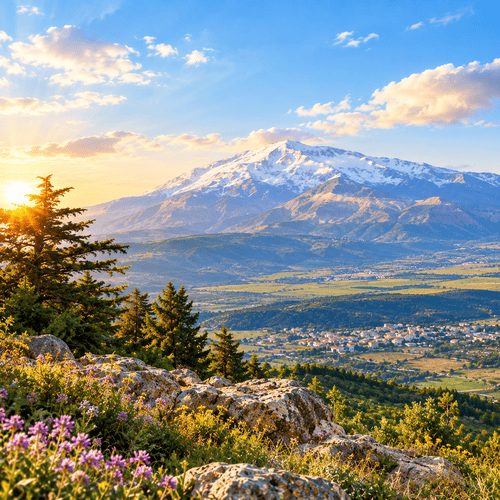
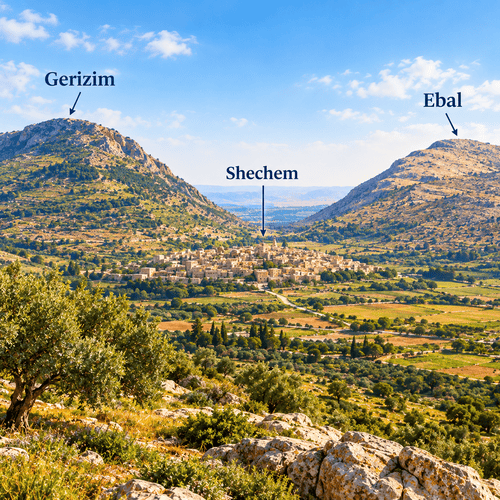
Two mountains stand face to face in the hills of Samaria. To the south is Mount Gerizim, about 880 metres high. To the north is Mount Ebal, about 940 metres high. Between them runs a narrow valley, less than a kilometre wide at its tightest point. The ancient town of Shechem stood here. Today the city of Nablus fills the same valley.
Here God told Israel to speak the blessings of His covenant from one mountain and the curses from the other. Here, centuries later, a Samaritan woman pointed up at Gerizim and asked Jesus where people should worship. And here the Old Testament quietly prepares us for the cross—where Christ took the curse so that we could receive the blessing.
This post is part of our Mountains of Scripture series on Old Testament mountains with New Testament meaning. We have already climbed Ararat, Moriah, Sinai, Zion, Carmel, the Mount of Olives, Nebo and Hermon. Now we come to a pair of mountains, Gerizim and Ebal. For the big picture, start with our overview, Mountains in the Bible: From Eden to the New Jerusalem.
Gerizim and Ebal at a Glance
| Feature | MOUNT GERIZIM | MOUNT EBAL |
|---|---|---|
| Height | About 880 metres | About 940 metres |
| Position | South side of the Shechem valley | North side of the Shechem valley |
| Old Testament role | Mountain of blessing (Deuteronomy 11:29) | Mountain of curse, and the place of Joshua’s altar (Deuteronomy 27:4; Joshua 8:30) |
| Later history | Samaritan temple, built in the 5th century BC | Early stone altar site found by Adam Zertal |
| New Testament link | “Our fathers worshipped on this mountain” (John 4:20) | “Cursed be everyone who does not abide…” (Galatians 3:10, quoting Deuteronomy 27:26) |
Where Are Gerizim and Ebal?
Shechem sits in the middle of the land, on the main north–south road. When Abraham entered Canaan, this was his first stop:
Abram passed through the land to the place at Shechem, to the oak of Moreh… Then the LORD appeared to Abram and said, “To your offspring I will give this land.”
Genesis 12:6–7, ESV
So the land promise was first spoken at Shechem, and God’s promises kept coming back to this valley.
Shechem Through the Bible: A Timeline
- Abraham: God promises the land at the oak of Moreh, near Shechem (Genesis 12:6–7).
- Jacob: Buys land and builds an altar at Shechem (Genesis 33:18–20).
- Moses: Commands the blessing and curse ceremony (Deuteronomy 11:29; 27).
- Joshua: Builds the altar on Ebal and reads the law between the mountains (Joshua 8:30–35); later renews the covenant at Shechem (Joshua 24).
- The judges: Jotham shouts his parable from the top of Gerizim (Judges 9:7).
- 5th century BC: The Samaritans build a temple on Gerizim.
- About 110 BC: The Jewish ruler John Hyrcanus destroys it.
- About AD 30: Jesus meets the Samaritan woman at Jacob’s well (John 4).
The Blessing and the Curse: What Happened Here
Before Israel entered the land, Moses gave this command:
And when the LORD your God brings you into the land that you are entering to take possession of it, you shall set the blessing on Mount Gerizim and the curse on Mount Ebal.
Deuteronomy 11:29, ESV
In Deuteronomy 27 he gave the details. Six tribes would stand on each mountain. The Levites would call out the covenant words, and the people would answer “Amen.” The law was to be written “very plainly” on plastered stones on Ebal (Deuteronomy 27:8). And on Ebal—the mountain of the curse—Israel was to build an altar:
And there you shall build an altar to the LORD your God, an altar of stones. You shall wield no iron tool on them.
Deuteronomy 27:5, ESV
Joshua obeyed. After the victory at Ai, he led the people to Shechem:
At that time Joshua built an altar to the LORD, the God of Israel, on Mount Ebal… And they offered on it burnt offerings to the LORD and sacrificed peace offerings.
Joshua 8:30–31, ESV
Then he read “all the words of the law, the blessing and the curse” (Joshua 8:34) to the whole nation—including the women, the children and the foreigners who lived among them (Joshua 8:35).
Three Details We Must Not Miss
- This was a covenant ceremony. Meredith Kline showed in Treaty of the Great King (1963) that Deuteronomy is shaped like an ancient treaty between a great king and his people. Such treaties ended with blessings for loyalty and curses for rebellion.
- Only the curses are spoken. Deuteronomy 27:15–26 gives twelve curses, each answered by “Amen.” No matching list of blessings is recited. Even in chapter 28 the curses take far more space. Moses knew how the story would go: “For I know that after my death you will surely act corruptly” (Deuteronomy 31:29).
- The altar stands on the mountain of curse. God did not put the altar on Gerizim, the mountain of blessing, but on Ebal. The place of sacrifice stood exactly where the curse was spoken.
HOLD ON TO THIS VERSE
“Cursed be anyone who does not confirm the words of this law by doing them.” And all the people shall say, “Amen.” (Deuteronomy 27:26, ESV)
This last curse on Ebal is the very verse Paul quotes in Galatians 3:10.
Archaeology: Did Adam Zertal Find Joshua’s Altar?
In 1980 Adam Zertal of the University of Haifa was surveying the hill country of Manasseh when his team noticed a large heap of stones on the north-eastern slope of Mount Ebal. Zertal was not setting out to prove the Bible. He excavated the site from 1982 to 1989.
What Zertal Found
- A large stone platform: A rectangular structure of rough fieldstones, roughly 9 by 7 metres and nearly 3 metres high. It was filled with earth, stones, ash and bones, with no doorway or living floor.
- A ramp, not steps: A ramp led up to the top. The law said, “you shall not go up by steps to my altar” (Exodus 20:26).
- Uncut stones: The stones were not shaped with tools, just as Exodus 20:25 and Deuteronomy 27:5 require.
- Burnt animal bones: Bones of young male bulls, sheep and goats—Israel’s sacrificial animals—many burnt in open fires.
- Dating clues: Early Iron Age pottery and two Egyptian scarabs pointed to the 13th–12th centuries BC. An earlier, smaller round structure lay underneath.
What the Critics Said
In 1986 Aharon Kempinski argued that it was a watchtower. Others raised three problems:
- Fallow deer: A notable share of the bones came from fallow deer. Deer were clean to eat (Deuteronomy 14:5) but are not on the list of sacrifices.
- The view: From the site itself you cannot see Mount Gerizim.
- The date: Zertal’s dates are later than the date many Bible readers hold for the conquest.
Weighing the Evidence
A watchtower, though, needs no ramp and is not filled with ash and burnt bones. Ralph Hawkins, in a full study published in 2012, concluded the structure is best explained as a place of worship. The fallow deer may simply show that early Israelite practice was imperfect—as Judges shows.
The view problem fades when we read Joshua 8 carefully. The altar was “on Mount Ebal” (8:30), but the people stood “in front of” both mountains (8:33), most naturally in the valley below.
The date is harder. Those holding an early conquest date (around 1400 BC, from 1 Kings 6:1) look to the earlier round structure beneath. Those holding a later date find Zertal’s dates fit well. Either way, we have an early place of sacrifice, unlike Canaanite temples, on the one mountain where the Bible says Israel built an altar.
OUR POSITION
We don’t claim archaeology has proved this is Joshua’s altar. We claim something more secure: the find fits the biblical account closely, and no better explanation has replaced it. Our confidence rests on God’s Word; archaeology confirms its setting is real.
The “Curse Tablet”: Exciting but Unproven
In December 2019 a team led by Scott Stripling of the Associates for Biblical Research wet-sifted soil Zertal’s team had thrown aside. They found a tiny folded piece of lead, a few centimetres across, and in 2022 announced that it hid a curse in early Hebrew letters naming YHW.
In 2023 the team—including Gershon Galil, Pieter Gert van der Veen and Czech scientists—published in Heritage Science. From X-ray scans they read about 40 letters and dated them to the Late Bronze Age, centuries before any known Hebrew inscription.
Critics answered in the Israel Exploration Journal. Aren Maeir and Christopher Rollston argued the scans show no clear letters. Amihai Mazar suggested a folded fishing-net weight, and Naama Yahalom-Mack traced the lead to Lavrion in Greece. Mark Haughwout added a rebuttal in 2024.
| QUESTION | THE DISCOVERY TEAM | THE CRITICS |
|---|---|---|
| Is there writing? | Yes—about 40 letters read from the scans | No clear letters can be seen |
| What is the object? | A folded curse tablet | A folded fishing-net weight |
| How old is it? | Late Bronze Age, from where it was found | Cannot be dated—it came from a dump pile, not a sealed layer |
Stripling replies that known lead net weights have grooves or holes and come from the coast, while this object has neither and was found inland. The debate continues. (We follow the story in more detail in Discovery of the Mt Ebal Curse Tablet: Where Things Stand.)
WHY WE DO NOT BUILD ON THE TABLET
A strong case never rests on its weakest evidence. The Bible’s account of Ebal does not need this tablet. If it is confirmed, wonderful; if not, nothing in our case changes. We serve the God of truth, so we should be the most careful people in archaeology.
Ebal or Gerizim? A Change in the Samaritan Bible
The Samaritans have their own version of the five books of Moses, the Samaritan Pentateuch. In Deuteronomy 27:4 it places the altar on Gerizim, and it adds an extra commandment after the Ten Commandments to build an altar there. Some scholars think “Gerizim” is original and Jewish scribes changed it. The evidence points the other way:
- The main witnesses agree: The Hebrew Masoretic Text and the ancient Greek translation (the Septuagint) both read Ebal.
- Joshua agrees: Joshua 8:30 places the altar on Ebal. The Samaritans never accepted Joshua as Scripture, so never edited it.
- The motive is clear: The Samaritans needed Gerizim to be the chosen mountain, and adding a whole commandment shows they would edit the text for it.
- The “Gerizim” scroll fragment is suspect: In 2009 James Charlesworth announced a small fragment of Deuteronomy 27:4 reading “Gerizim” as a Dead Sea Scroll. In 2025 the publisher of his study added a notice that later research argues it is a modern forgery.
- Archaeology agrees: Yitzhak Magen’s twenty years of digging on Gerizim showed its sanctuary began in the 5th century BC. The only early altar found is on Ebal.
“Our Fathers Worshipped on This Mountain”
Around AD 30, Jesus stops at Jacob’s well near Sychar, at the foot of Mount Gerizim (John 4:5–6). When He shows a Samaritan woman that He knows her life, she turns to the great dispute between Jews and Samaritans:
Our fathers worshipped on this mountain, but you say that in Jerusalem is the place where people ought to worship.
John 4:20, ESV
The Samaritan temple had lain in ruins for over a century, but the mountain was still holy to her people. Jesus answered:
Woman, believe me, the hour is coming when neither on this mountain nor in Jerusalem will you worship the Father… the true worshippers will worship the Father in spirit and truth.
John 4:21, 23, ESV
Jesus does not say both sides were equally right: “salvation is from the Jews” (4:22). But soon neither mountain will matter, because the true temple was standing in front of her. Jesus had already said of His own body, “Destroy this temple, and in three days I will raise it up” (John 2:19). When the woman speaks of the coming Messiah, Jesus replies, “I who speak to you am he” (John 4:26).
The argument over the mountains ends in a Person. Many Samaritans confessed Him as “the Saviour of the world” (John 4:42), and the gospel later spread through Samaria (Acts 8:5–8).
Christ Redeemed Us from the Curse of the Law
In Galatians 3, Paul goes straight back to Mount Ebal:
For all who rely on works of the law are under a curse; for it is written, “Cursed be everyone who does not abide by all things written in the Book of the Law, and do them.”
Galatians 3:10, ESV
That is Deuteronomy 27:26—the last curse spoken on Ebal. The law demands complete obedience, and no one has kept it. So all who stand before God on their own law-keeping stand under Ebal’s curse. Then comes the good news:
Christ redeemed us from the curse of the law by becoming a curse for us—for it is written, “Cursed is everyone who is hanged on a tree”—so that in Christ Jesus the blessing of Abraham might come to the Gentiles, so that we might receive the promised Spirit through faith.
Galatians 3:13–14, ESV
That quotation comes from Deuteronomy 21:23. Now look at the verse just before Joshua builds the altar on Ebal:
And he hanged the king of Ai on a tree until evening. And at sunset Joshua commanded, and they took his body down from the tree.
Joshua 8:29, ESV
In Joshua 8, the cursed tree stands right beside the altar on the mountain of curse—the two things Paul joins in Galatians 3. At Calvary they became one. Jesus hung on the tree, and His body too was taken down before nightfall (John 19:31).
One Saviour, Two Mountains
The two mountains show the two things we need, and Christ has done both.
- Gerizim—the blessing earned: The blessings were promised to those who obey. We have not obeyed, but Christ obeyed perfectly in our place. By His obedience “the many will be made righteous” (Romans 5:19).
- Ebal—the curse carried: Christ, who never broke the law, took its curse on Himself at the cross. God “made him to be sin who knew no sin” (2 Corinthians 5:21).
The Westminster Confession of Faith (8.5) says Christ satisfied God’s justice by His “perfect obedience, and sacrifice of himself.” John Calvin, on Galatians 3:13, stressed that Christ was cursed not for His own sin but for ours.
This is why the altar had to be on Ebal. No one reaches the blessing by climbing Gerizim in their own strength. It comes only through the sacrifice on the mountain of the curse—and through Christ “the blessing of Abraham,” first promised at Shechem, now reaches the nations.
What Gerizim and Ebal Mean for Us Today
- Take God’s law seriously. God’s standard has not changed, and it still shows our need of a Saviour.
- Stop looking for a holy mountain. No place makes worship more acceptable. True worship is in spirit and truth, through Christ.
- Rest in what Christ has done. If you trust in Jesus, no curse is left for you: “There is therefore now no condemnation for those who are in Christ Jesus” (Romans 8:1).
- Read the Bible with confidence. The places are real, and the story leads to Christ.
The law was once written on plastered stones on Mount Ebal. Now God writes it “not on tablets of stone but on tablets of human hearts” (2 Corinthians 3:3). The mountain of curse has given way to the cross—and the cross to a blessing that will never end.
Tough Questions, Honest Answers
Why was Gerizim chosen for blessing and Ebal for cursing?
The Bible does not say. One common suggestion is about direction. People in the ancient Near East thought of directions while facing east. Facing east, Gerizim in the south is on the right hand—often a symbol of favour in Scripture—and Ebal in the north is on the left. Travellers also notice that the slopes of Ebal facing the valley look barer and rockier. These ideas may help, but the real point is not in the rocks. God chose the places, and His Word gave them their meaning.
Why were the tribes divided between the mountains the way they were?
On Gerizim stood Simeon, Levi, Judah, Issachar, Joseph and Benjamin—all sons of Jacob’s wives Leah and Rachel. On Ebal stood Reuben, Gad, Asher, Zebulun, Dan and Naphtali (Deuteronomy 27:12–13). These include all four sons of the servant women Bilhah and Zilpah, along with Reuben, who lost his place as firstborn because of his sin (Genesis 49:3–4), and Zebulun, Leah’s youngest son. The Bible does not explain the split, so we should hold any theory loosely. What matters is that the whole nation took part and said “Amen.”
What are the 12 curses of Deuteronomy 27?
The Levites spoke curses on anyone who: makes a secret idol; dishonours father or mother; moves a neighbour’s boundary marker; misleads a blind person; denies justice to the foreigner, the orphan or the widow; commits one of four sexual sins named in the list; secretly strikes down a neighbour; takes a bribe to kill an innocent person; and, finally, does not keep the whole law (Deuteronomy 27:15–26). Many of these sins are done in secret. The message is clear: God sees what others cannot, and His law reaches the heart.
Who are the Samaritans, and do they still worship on Mount Gerizim?
The Bible traces their origin to the time after Assyria conquered the northern kingdom in 722 BC, when foreign peoples were settled there and mixed their worship with the worship of the LORD (2 Kings 17:24–41). The Samaritans themselves say they descend from the northern tribes of Ephraim and Manasseh, and from priests of Levi. A small Samaritan community—fewer than a thousand people—still exists today. Part of it lives on Mount Gerizim, and every year they still sacrifice lambs there at Passover.
Did Abraham offer Isaac on Mount Gerizim?
Samaritans believe so, but the Bible points elsewhere. God sent Abraham to “the land of Moriah” (Genesis 22:2), and Solomon later built the temple “on Mount Moriah” in Jerusalem (2 Chronicles 3:1). Jewish and Christian tradition has always linked the two. We explain this further in our post on Mount Moriah.
Can you visit Mount Ebal and Joshua’s altar today?
Both mountains are in the West Bank, beside Nablus. The archaeological site on the summit of Gerizim, near the Samaritan village, has often been open to visitors. The Ebal altar site is harder to reach, and visits usually happen through organised groups when the security situation allows. Rules and conditions change often, so always check current official travel advice before planning a visit.
Can a Christian be under a curse today?
No. Christ “redeemed us from the curse of the law by becoming a curse for us” (Galatians 3:13), and “there is therefore now no condemnation for those who are in Christ Jesus” (Romans 8:1). Many people worry about “generational curses,” but God says, “The son shall not suffer for the iniquity of the father” (Ezekiel 18:20). Believers still face the results of sin and receive the Father’s loving discipline (Hebrews 12:6). But discipline is not a curse. It is the care of a Father for His children.
Related Reads
- Mountains in the Bible: From Eden to the New Jerusalem
- Mount Ararat in the Bible: Where Judgement Ended and Rescue Began
- Mount Moriah in the Bible: Araunah’s Threshing Floor and Why It Matters
- Mount Sinai in Arabia: What Paul Meant in Galatians 4:25
- Mount Nebo (Pisgah): The Law, the Promise and Rest Christ Gives
- Mount Zion Meaning: From David’s Hill to the People of God
- Mount Carmel in the Bible: Elijah’s Fire and the Cross of Christ
- Mount of Olives in the Bible: Where the King Wept and the Glory Returns
- Mount Hermon in the Bible: Dew, Watchers and the Gates of Hell
- Discovery of the Mt Ebal Curse Tablet: Where Things Stand
- Jesus in Deuteronomy: Prophet, Covenant-Keeper, Curse-Bearer
- Penal Substitutionary Atonement: The Heart of the Gospel Explained
- Why Did God Give Us the Law? Understanding Law and Grace
- True Worship That God Delights In: Insights from Scripture