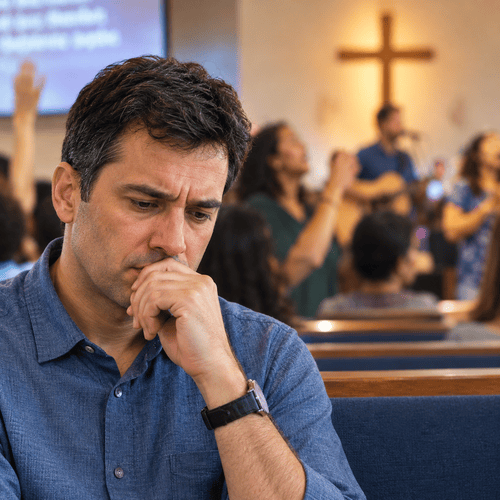

Imagine working hard for 7 years and having nothing to show for it. No reward. No praise. Not one result.
That was William Carey’s story. In 1793 he sailed from England to India to tell people about Jesus. He learned the local languages. He translated the Bible. He preached in villages and markets. He buried a young son. His wife’s mind broke under the strain. And for 7 long years, not one Indian person turned to Christ through his work.
By today’s standards, many would call Carey a failure. Some of us would have quietly gone home.
Perhaps we’re smaller versions of that story. We’ve spoken to friends about Jesus many times. We’ve prayed for siblings for 20 years. Nothing has changed. They’re polite, or they laugh, or they simply don’t care.
So we start to wonder: Am I doing something wrong? Is God not with me? Should I just stop?
This post is part of our series What Do We Do When…?, which takes the hard moments of the Christian life to Scripture and asks how God would have us respond. Other posts in the series ask what we do when God seems distant and silent, when God closes a door we prayed would open, when we don’t know what step to take next, when we fall into the same sin again, when life doesn’t go according to plan, when doubt and anxiety won’t let go, when we can’t forgive someone, when we feel trapped in a meaningless existence, when we’re afraid of the future, when our family opposes our faith, when we have no feelings for God and when we’re afraid to evangelise…
Today’s question troubles many believers quietly: what do we do when our evangelism seems to bear no fruit?
The Bible’s answer may surprise us. God asks us to be faithful, not successful. And there’s real freedom in that. Let’s see why.
KEY TERMS
- Evangelism: telling people the good news (the gospel) about Jesus. We are sinners. Jesus died for sinners and rose again. All who turn from sin and trust in Him will be forgiven.
- Fruit: in this post, the visible results of our evangelism—especially people coming to faith in Christ.
- Conversion: a person turning away from sin and trusting in Jesus as Saviour and Lord.
1. Evangelism Is About the Message, Not the Results
Many of us carry hidden ideas: “If someone believes, I have succeeded. If no one believes, I have failed.” But that isn’t what the Bible teaches.
Think about a postman. His job is to deliver the letter to the right house. He isn’t responsible for whether the person opens it, reads it or acts on it. If he delivers the letter faithfully, he’s done his job well.
Evangelism works that way too. Our task is to deliver God’s message as best we can. What happens next isn’t in our hands. Paul writes:
Moreover, it is required of stewards that they be found faithful.
1 Corinthians 4:2
A steward is a servant who looks after something that belongs to his master. Notice what God requires. Not success. Faithfulness.
JI Packer made this point in his classic book Evangelism and the Sovereignty of God. He argued we shouldn’t judge whether we’re really evangelising by counting conversions. We should ask whether we’re faithfully making the gospel known.
2. Only God Can Give New Life
Why can’t we produce results ourselves? Because conversion isn’t a human achievement. Before anyone can truly turn to Christ, something must happen deep inside them. Jesus called it being “born again” (John 3:3). God gives new life to a heart that’s spiritually dead.
Paul explains this using a picture from farming:
I planted, Apollos watered, but God gave the growth. So neither he who plants nor he who waters is anything, but only God who gives the growth.
1 Corinthians 3:6–7
Paul started the church in Corinth. Apollos taught there later. But neither could make a single person grow spiritually. Only God could.
Jesus said the same thing:
No one can come to me unless the Father who sent me draws him.
John 6:44
To draw means to pull someone towards us. No one comes to Jesus by their own strength. We see this with Lydia, a businesswoman in Philippi. Luke tells us, “The Lord opened her heart to pay attention to what was said by Paul” (Acts 16:14). Who opened her heart? Not Paul. Not his clever words. The Lord.
WHY THIS IS GOOD NEWS FOR US
If conversion depended on our skill, every unbelieving friend would be our personal failure. But it doesn’t. We cannot argue anyone into God’s kingdom. We cannot charm them in. And we cannot keep one of God’s people out by a clumsy sentence. “Salvation belongs to the Lord!” (Jonah 2:9).
3. God’s Control Is Our Hope, Not Our Excuse
KEY TERMS
- Sovereignty: God’s complete rule and control over everything, including salvation.
- Election: God’s choice, before the world began, of the people He would save (Ephesians 1:4).
Some ask, “If God has already chosen who will be saved, why bother sharing the gospel?” The Bible says the opposite: God’s choice is the very reason to keep going.
In Corinth, Paul faced strong opposition. Then the Lord spoke to him in a vision:
Do not be afraid, but go on speaking and do not be silent, for I am with you, and no one will attack you to harm you, for I have many in this city who are my people.
Acts 18:9–10
Notice this. God said He had “many” people in Corinth—yet they had not believed yet! They belonged to God, but they still needed to hear the gospel. So Paul stayed a year and a half, teaching God’s word (Acts 18:11). God’s plan did not make Paul lazy. It made him bold.
Packer argued that God’s sovereignty does not make evangelism pointless. It is our only hope that evangelism will succeed at all. Without God’s power, no dead heart would ever respond.
In 1618–19, church leaders from across Europe met at the Synod of Dort in the Netherlands. In the Canons of Dort, they wrote that God’s saving work does not remove the use of “means”—it requires them. Means are the tools God uses, such as preaching. God has chosen both who will be saved and how they will hear. You are one of His means.
4. God’s Word Never Comes Back Empty
God makes a wonderful promise about His word:
So shall my word be that goes out from my mouth; it shall not return to me empty, but it shall accomplish that which I purpose, and shall succeed in the thing for which I sent it.
Isaiah 55:11
“But,” you may say, “my friend heard the gospel and walked away. Wasn’t that wasted?” Paul answers:
For we are the aroma of Christ to God among those who are being saved and among those who are perishing, to one a fragrance from death to death, to the other a fragrance from life to life.
2 Corinthians 2:15–16
An aroma is a smell. The same gospel smells like life to some people and like death to others. John Calvin, the sixteenth-century French pastor and Bible teacher, explained that the gospel is never preached in vain. It always has an effect—either for life or for death.
God told Ezekiel the same before sending him to a stubborn nation: “whether they hear or refuse to hear… they will know that a prophet has been among them” (Ezekiel 2:5).
| WHEN A PERSON HEARS THE GOSPEL AND… | WHAT GOD IS DOING | WHAT IT SHOWS |
|---|---|---|
| …believes | Giving new life through His word | God’s mercy and saving power |
| …refuses | Giving a clear warning; leaving them without excuse | God’s fairness and justice |
| …is unsure | Planting a seed that may grow later | God’s patience |
5. Faithful Servants Who Saw Little Fruit
If visible results were the test, some of the Bible’s greatest heroes would fail:
| SERVANT OF GOD | HOW LONG HE SERVED | WHAT HE SAW | BIBLE REFERENCE |
|---|---|---|---|
| Noah | Many years, building the ark and warning people | Only his own family of eight was saved | Genesis 6–7; 2 Peter 2:5 |
| Isaiah | Several decades | God told him from day one that most would not listen | Isaiah 6:9–13 |
| Jeremiah | Over 40 years | Mocked, beaten and thrown into a muddy well; very few believed | Jeremiah 20:2, 7; 38:6 |
| Jesus | About 3 years of public ministry | Crowds left Him; at His arrest His followers ran away | John 6:66; Mark 14:50 |
| Paul in Athens | 1 visit | Some mocked, some wanted to hear more, a few believed | Acts 17:32–34 |
Was Jeremiah a failure? Was Jesus? Of course not. Peter calls Noah “a herald of righteousness” (2 Peter 2:5). A herald is a messenger who announces a king’s message in public. A herald is judged by whether he announced the message, not by how many people obeyed it.
6. Fruit Often Comes Later—and Someone Else May Gather It
Farmers know that seeds take time. Jesus told this short parable:
The kingdom of God is as if a man should scatter seed on the ground. He sleeps and rises night and day, and the seed sprouts and grows; he knows not how.
Mark 4:26–27
The seed keeps growing in secret. Your words to a friend may be growing in their heart right now, even though you see nothing.
Sometimes the sower never sees the harvest at all:
For here the saying holds true, “One sows and another reaps.” I sent you to reap that for which you did not labour. Others have laboured, and you have entered into their labour.
John 4:37–38
You may be the first person to speak to your colleague about Jesus. God may use a stranger to bring them to faith 20 years from now. It is all one work.
Timeline: Faithful Sowing, Delayed Harvest
- 1793: William Carey arrives in India.
- 1793–1800: Seven years of preaching and translating. No Indian converts.
- 1800: Krishna Pal, a carpenter, is baptised—the first Indian convert of Carey’s mission.
- 1813: Adoniram Judson arrives in Burma (today’s Myanmar).
- 1819: After six years of hard work, Judson baptises his first Burmese believer.
Carey later described himself simply: “I can plod. I can persevere in any definite pursuit. To this I owe everything.” When Judson was once asked about the prospects for the gospel in Burma, he reportedly replied, “The prospects are as bright as the promises of God.”
And let us not grow weary of doing good, for in due season we will reap, if we do not give up.
Galatians 6:9
7. Fruit Is Bigger Than Conversions
When Jesus’ 72 disciples came back thrilled with their success, He gently corrected them: “Do not rejoice in this, that the spirits are subject to you, but rejoice that your names are written in heaven” (Luke 10:20). Our deepest joy must rest on what God has done for us, not on visible results.
Conversions are precious, but they’re not the only fruit God values:
| KIND OF FRUIT | WHAT IT LOOKS LIKE | BIBLE REFERENCE |
|---|---|---|
| Faithfulness | Continuing to share the gospel even when no one responds | 1 Corinthians 4:2 |
| Christlike character | Love, patience and gentleness growing in you | Galatians 5:22–23 |
| Seeds sown | Gospel words planted that may grow years later | Mark 4:26–29 |
| Witness given | People hearing the truth, even if they reject it | Ezekiel 2:5 |
| Glory to God | God honoured when the truth about Him is spoken | 1 Corinthians 10:31 |
| Conversions | People turning from sin to trust in Christ | Acts 2:41 |
We should pray and long for conversions. But we must never make them the only measure of whether God is pleased with us.
Two Ditches to Avoid
Picture a road with a ditch on each side. When evangelism seems fruitless, we can fall into either.
| Aspect | DITCH 1: DOING NOTHING | DITCH 2: DOING ANYTHING |
|---|---|---|
| What it says | “God will save His people anyway, so I don’t need to speak.” | “If no one responds, I must change the message or push harder.” |
| Why it is wrong | God saves people through the gospel being told. Silence is disobedience. | Pressure and tricks can produce false converts. Only God gives true life. |
| What the Bible says | “How are they to hear without someone preaching?” (Romans 10:14) | The gospel “is the power of God for salvation” (Romans 1:16) |
The safe road runs between them: we speak boldly and trust God fully. Paul believed firmly in God’s choice, yet he wrote, “Brothers, my heart’s desire and prayer to God for them is that they may be saved” (Romans 10:1). Charles Spurgeon, the great nineteenth-century London preacher, held the same beliefs about God’s sovereignty. Yet he pleaded with passion:
If sinners be damned, at least let them leap to hell over our bodies.
Charles Spurgeon
Before We Blame the Soil: An Honest Check-Up
In the Parable of the Sower (Matthew 13:1–23), most of the seed falls on bad soil. Hard hearts are real. But before we blame the soil, we should make sure we are actually sowing good seed.
5 HONEST QUESTIONS TO ASK
- Am I actually sharing the gospel? Kindness is good, but kindness alone does not tell people that Jesus died and rose again for sinners.
- Is it the real gospel? “Jesus will make your life better” is not the gospel. Sin, the cross, repentance and faith are at its heart.
- Am I praying for them? Jesus told us to “pray earnestly to the Lord of the harvest” (Matthew 9:38).
- Does my life match my words? Peter tells us to share our hope “with gentleness and respect” (1 Peter 3:15).
- Am I patient? Or do I give up after one conversation?
If these show some weakness, confess it and keep going. But if you are honestly being faithful, the lack of fruit is not your failure. It is God’s timing.
When Discouragement Creeps In
- Stop comparing. God gives different work to different servants. Paul planted; Apollos watered.
- Remember you are not alone. Evangelism is the whole church’s work. Your conversation may be one link in a long chain.
- Hard places are not failed places. In some parts of the world, including parts of India, following Jesus can cost a person their family, job or community. Slow growth in such places does not mean God is absent.
- Be patient with family. Those closest to us are often hardest to reach.
- Pray more than you worry. Worry looks at the soil. Prayer looks to the Lord of the harvest.
So What Do We Do?
- Keep sowing: share the gospel clearly, kindly and often.
- Keep praying: ask God to open hearts, as He opened Lydia’s.
- Keep checking yourself: keep your message and your life faithful.
- Keep trusting: the results belong to God.
- Keep rejoicing: your name is written in heaven.
Therefore, my beloved brothers, be steadfast, immovable, always abounding in the work of the Lord, knowing that in the Lord your labour is not in vain.
1 Corinthians 15:58
William Carey died in India in 1834. By then, he and his co-workers had translated the Bible, in whole or in part, into dozens of languages. Those seven silent years were not wasted. They were the seed.
Neither are yours.
Tough Questions, Honest Answers
Am I to blame if someone I shared the gospel with dies without Christ?
God told Ezekiel that a watchman who warns the people has done his duty, even if they ignore the warning (Ezekiel 33:7–9). Paul could say, “I am innocent of the blood of all, for I did not shrink from declaring to you the whole counsel of God” (Acts 20:26–27). If you have faithfully shared the gospel, the person’s rejection is not your guilt. “Each of us will give an account of himself to God” (Romans 14:12). This truth should not make us careless, but it should free us from a burden only God can carry.
Is every Christian called to evangelise, or only those with a special gift?
God gives some believers a special gift as evangelists (Ephesians 4:11). These people often preach to crowds or lead outreach. But every Christian is called to be a witness. Peter says all believers exist to “proclaim the excellencies of him who called you out of darkness into his marvellous light” (1 Peter 2:9). Not everyone will preach a sermon, but everyone can tell others what Jesus has done.
When should I stop sharing the gospel with someone who keeps refusing?
Jesus told His disciples to “shake off the dust from your feet” when a town refused to listen (Matthew 10:14). He also warned against pushing holy things on those who only mock them (Matthew 7:6). So there may be times to stop speaking for a season, especially when someone is hostile. But we never stop praying for them, and we never stop loving them. Often a person who refused for years becomes open after a crisis, so stay ready.
How can I share the gospel with my family without damaging the relationship?
Family members know us best, so they quickly notice if our lives do not match our words. Peter says some can be won “without a word” through our conduct (1 Peter 3:1). Be patient, humble and quick to say sorry when you are wrong. Share your own story of what Jesus has done for you rather than lecturing. Look for natural moments, and pray more than you preach.
What if I am too afraid to share my faith?
Fear is normal—even Paul asked others to pray that he would speak “boldly” (Ephesians 6:19–20). The early church prayed for boldness, and God answered (Acts 4:29–31). Remember that “God gave us a spirit not of fear but of power and love and self-control” (2 Timothy 1:7). Start small: tell one friend why you go to church, or offer to pray for someone. Courage grows as you obey.
Should I ask people to pray a “sinner’s prayer”?
The Bible never gives a set prayer that saves a person. Jesus called people to “repent and believe in the gospel” (Mark 1:15). A prayer can be a sincere way of expressing that faith, but words alone do not save—only true faith in Christ does. The danger is that someone repeats a prayer and then believes they are safe, even if nothing has changed. It is better to explain the gospel clearly, urge people to repent and trust Christ, and then help them grow.
What is the difference between evangelism and apologetics?
Evangelism is telling people the good news about Jesus. Apologetics comes from the Greek word apologia, meaning “a defence”, and it means giving reasons for the Christian faith (1 Peter 3:15). Apologetics answers questions and removes obstacles, such as doubts about the Bible or God’s existence. Evangelism then points people to Christ Himself. Both are useful, but neither can change a heart—only the Holy Spirit can do that.
Related Reads
- What Do We Do When God Seems Distant and Silent?
- What Do We Do When God Closes a Door We Prayed Would Open?
- What Do We Do When We Don’t Know What Step to Take Next?
- What Do We Do When We Fall Into the Same Sin Again?
- What Do We Do When Life Doesn’t Go According to Plan?
- What Do We Do When Doubt and Anxiety Won’t Let Go?
- What Do We Do When We Can’t Forgive Someone?
- What Do We Do When We Feel Trapped in Meaningless Existence?
- What Do We Do When We’re Afraid of the Future?
- What Do We Do When Our Family Opposes Our Faith?
- What Do We Do When We Have No Feelings for God?
- What Do We Do When We’re Afraid to Evangelise?
- What Is Hyper-Calvinism—and Why Do Calvinists Reject It?
- Irresistible Grace: How God’s Call Actually Works
- Regeneration Or Faith? Which Comes First in Salvation?
- Why Work Hard If God Is Sovereign and Already Knows the Outcome?
- If God Is Sovereign, Why Bother Praying?
- Do Altar Calls Help or Hurt Evangelism?
- Apologetics in Evangelism: Combining Reason and Love
- The Synod of Dort: The Debate That Gave Us TULIP
- Can We Be Saved If We’ve Never Evangelised?