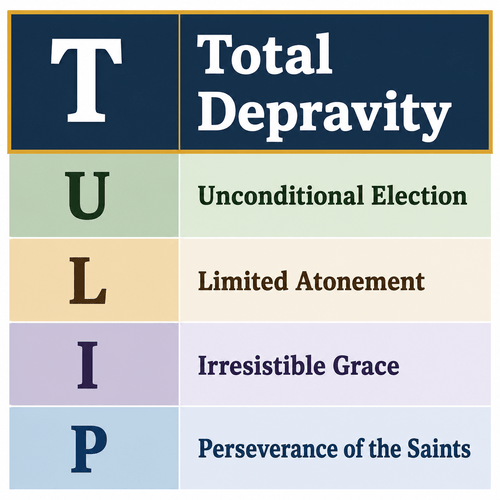
This post is part of our five-part series on the Doctrines of Grace—the biblical teachings known by the acronym TULIP. The name “Doctrines of Grace” reflects the Reformed conviction that every one of the five points answers the same question from a different angle: whose doing is salvation? Total Depravity shows why we cannot save ourselves. Unconditional Election shows us God’s choice rests on His grace, not our merit. Limited Atonement shows Christ’s death actually secured our redemption. Irresistible Grace shows us God’s call overcomes our resistance. Perseverance of the Saints shows us God keeps us to the end. Together, the five make the case that salvation belongs to God—from first to last.
Of all the things Calvinism is accused of, teaching total depravity is probably what earns it the most contempt. The very phrase sounds like a verdict—as though Reformed Christians look at the human race and see nothing but sewage. Mention it in a church small group and watch the faces.
But total depravity isn’t what most of its critics think it is. And once you understand what it actually teaches—and why the Bible insists on it so forcefully—we begin to see it isn’t the most pessimistic doctrine in Christian theology. It’s in a way, the most hopeful. Because total depravity is the doctrine that makes grace make sense.
This is the first instalment in our series on TULIP, and we start here deliberately. Total depravity isn’t just one of five equal points. It’s the foundation on which the other four are built. Get this one wrong and the entire architecture of Reformed soteriology collapses.
What “Total” Does—and Doesn’t—Mean
The word “total” is the source of nearly every misunderstanding, so let’s settle it at the outset.
Total depravity doesn’t mean humanity is as wicked as it could possibly be. It doesn’t mean no unregenerate person can ever do anything admirable, kind, or socially praiseworthy. History is full of atheists who were devoted fathers, non-Christians who gave generously to the poor, and irreligious people who showed extraordinary courage and decency.
What “total” means isn’t utter but pervasive. Sin hasn’t made us as bad as we could be, but it has spread to every part of what we are: our intellect, our will, our emotions, our desires, and our conscience. There is no faculty in the unregenerate person that stands untouched by the Fall. The corruption is total in its reach, not in its depth.
The crucial implication is this: fallen human beings aren’t merely weakened or wounded in their ability to come to God. They’re, by their very nature, incapable of seeking Him, choosing Him, or delighting in Him—unless God first intervenes.
It’s the difference between a drowning man struggling to reach the shore and a dead man lying on the seabed. The first needs assistance; the second needs resurrection.
The Biblical Case for Total Depravity
This isn’t a doctrine invented by John Calvin in 16-century Geneva. It runs like a thread through the whole of Scripture.
- Jeremiah 17:9: “The heart is deceitful above all things and desperately sick; who can understand it?” The prophet doesn’t say the human heart is occasionally unreliable. He says it’s deceitfully and desperately corrupt—and that its corruption is so deep we can’t even diagnose it accurately ourselves.
- Genesis 6:5: Before the Flood, God surveys the human race and observes “every intention of the thoughts of his heart was only evil continually.” The assessment is unsparing: every intention, only evil, continually. This isn’t a description of a particularly bad era; it’s a description of human nature.
- Psalm 51:5: David’s great confession after his sin with Bathsheba doesn’t locate his failure in a moment of weakness. He traces it to its root: “in sin did my mother conceive me.” The problem isn’t what David did; it’s what David is. Corruption precedes action, and precedes birth.
- Romans 3:10-12: Paul’s sweeping indictment of the human race draws from the Psalms: “None is righteous, no, not one; no one understands; no one seeks for God. All have turned aside; together they have become worthless; no one does good, not even one.” Three times “no one.” Twice “not one.” This is total depravity expressed in its starkest biblical form.
- Ephesians 2:1-3: Paul addresses the Ephesian believers and reminds them of what they were before Christ: “dead in the trespasses and sins in which you once walked, following the course of this world, following the prince of the power of the air, the spirit that is now at work in the sons of disobedience—among whom we all once lived in the passions of our flesh.” Dead. Following Satan. Living in the passions of the flesh. This is the condition of every human being outside of Christ.
- John 6:44: Jesus Himself states the implication plainly: “No one can come to me unless the Father who sent me draws him.” The word “can” is important. Jesus isn’t saying people choose not to come; He is saying they cannot come without prior divine action. The inability is real.
- 1 Corinthians 2:14: “The natural person doesn’t accept the things of the Spirit of God, for they are folly to him, and he is not able to understand them because they are spiritually discerned.” The unregenerate person does not merely find the gospel unpersuasive—he finds it foolish. And he cannot grasp it, because the spiritual capacity to do so has been destroyed by sin.
The “Dead” Metaphor—and Why It Changes Everything
Paul’s most striking image for the human condition in sin is not “sick.” It is not “wounded.” It is not “confused.” It is dead (Ephesians 2:1).
This is not poetic excess. It is a precise theological claim. Dead people do not cooperate with their own resuscitation. They do not summon the will to respond to the doctor’s call. They do not meet God halfway. They need to be made alive before they can do anything—and that is exactly what Paul says God does in the next verse: “But God, being rich in mercy, because of the great love with which he loved us, even when we were dead in our trespasses, made us alive together with Christ” (Ephesians 2:4-5).
Ezekiel’s vision of the valley of dry bones (Ezekiel 37) makes the same point through unforgettable imagery. The valley is full of bones—dry, scattered, completely lifeless. Ezekiel is commanded to prophesy to them, and as he does, the bones come together, flesh forms, and breath enters them. But notice what the bones do not do: they do not stir on their own, gather themselves, or ask for help. Life comes entirely from outside them, at God’s initiative, through his word.
This is the picture of regeneration. We were the bones. God was the breath.
Total Depravity and the Will
At this point, someone always asks the free-will question. If we are totally depraved, are we not simply robots? Are we truly responsible for our sin if we could not do otherwise?
This is where the doctrine requires careful handling. Total depravity does not eliminate the will. It describes the condition of the will.
Augustine captured it with a distinction that has stood for sixteen centuries. Before the Fall, Adam was posse non peccare—able not to sin. He could choose either direction. After the Fall, fallen humanity is non posse non peccare—not able not to sin. Not because we are coerced against our wishes, but because sin has so thoroughly shaped our desires that we want what is wrong. We choose freely—but we cannot choose beyond the boundaries of our corrupted nature.
Jesus expresses this in John 8:34: “Everyone who commits sin is a slave to sin.” A slave does what the master commands. He may do it willingly—he may even love the master—but he is not free. We sin because we are sinners, and we love our sin because our nature has been bent towards it. The problem is not that we are forced against our will. The problem is that our will itself is the problem.
This is why total depravity is sometimes called total inability. It is not inability to make choices; it is inability to make the choice that matters most—the choice to turn from sin to God—without his prior, regenerating grace.
Common Grace—Why the World Isn’t Worse
If human beings are truly this corrupted, how do we explain the remarkable achievements of unregenerate people—the art, the heroism, the self-sacrifice, the civilisations they build? Why is the world not simply a wasteland of unrestrained wickedness?
The answer is common grace: God’s general, non-saving goodness extended to all humanity by which he restrains the full expression of sinful nature and enables human beings to function as bearers of his image, however distorted. Common grace is the reason the roads get built, the hospitals get funded, and parents who do not know God still love their children fiercely.
But common grace does not contradict total depravity. It explains why the doctrine’s effects are not always maximally catastrophic—but it does not change what human beings are by nature. Even the most admirable unregenerate person, performing the most socially beneficial acts, does so without reference to God’s glory, from a heart that has not been reconciled to God, and in a way that falls short of what God requires. Common grace restrains the expression of depravity; it does not remove its root.
Why Total Depravity Is the Foundation of All the Others
Here’s the point that is most often missed: total depravity is not merely the first of five equal points. It is the load-bearing wall of the entire Reformed system.
If human beings are not totally depraved—if they retain some uncorrupted faculty by which they can seek God, respond to the gospel, or contribute to their own salvation—then unconditional election is unnecessary (God could simply choose those who choose him). Limited atonement becomes incoherent (Christ only needed to make salvation possible, not certain). Irresistible grace is redundant (the gospel message alone would be enough if people were capable of responding). Perseverance of the saints becomes a human achievement rather than a divine guarantee.
In other words: if total depravity falls, TULIP falls. If, on the other hand, human beings are genuinely dead in sin, then unconditional election, particular redemption, effectual calling, and keeping grace are not theological luxuries. They are the only way anyone gets saved.
The Surprising Good News of Total Depravity
Here is the twist. Total depravity, for all its apparent bleakness, is the doorway to the most exhilarating truth in theology: that God saves the utterly helpless.
Because we cannot save ourselves, God saves us entirely. Because we would not seek him, he sought us. Because we were spiritually dead, he made us alive. Because our will was enslaved, he freed it—not by overriding it, but by renewing it, so that the thing we now want most is the thing that is best for us.
The Christian does not say, “I found God.” The Christian says, “I was found.” The Prodigal Son does not drag himself out of the pigsty and walk home in his own strength. He “comes to himself”—a phrase that echoes regeneration—and the moment he does, the Father is already running.
Total depravity is the bad news that makes the good news genuinely good. It tells us precisely why we needed rescuing, which is the only way we can understand why the rescue is so extraordinary.
Tough Questions, Honest Answers
Doesn’t total depravity mean humanity is as evil as possible?
No—this is the most common misunderstanding. Total depravity means sin has affected every part of human nature, not that every person has reached the maximum degree of wickedness. It’s total in its reach (every faculty has been corrupted) rather than in its depth (not all are bad as they could be). Unregenerate people can and do perform acts of great kindness—but even those acts are tainted by sin in their ultimate orientation. And they fall short of what God requires.
If we can’t choose God, are we really responsible for not doing so?
Yes, because our inability isn’t external compulsion but internal corruption. We don’t choose God because we don’t want God—and we’re responsible for the desires that shape our choices. A man who refuses to eat because he has destroyed his appetite through excess is responsible for his hunger, even though he can’t now eat. We sin voluntarily, in line with our desires, and that voluntary character makes us morally culpable.
How does total depravity relate to the image of God?
Human beings retain the image of God (imago Dei) after the Fall—we’re still rational, relational, and moral beings, unlike the animals. But the image is defaced, even distorted, but not erased. Think of it like a painting that’s been dragged through the mud: you can still see the original, but it is obscured. Total depravity describes this defacement of the image, not its complete destruction.
Doesn’t Romans 2:14-15 say Gentiles do the law by nature? How does that square with total depravity?
Paul’s point in Romans 2:14-15 is that Gentiles demonstrate they have a moral conscience—the work of the law “written on their hearts”—when they act in accordance with its requirements. This is an expression of common grace and the residual image of God. But Paul isn’t saying they fulfil the law adequately or that this conscience is sufficient for salvation. His argument throughout Romans 1-3 is that all—Jew and Gentile alike—fall short and are without excuse. The moral sense he describes in Romans 2 doesn’t contradict total depravity; it explains why the condemnation of Romans 3 is universal.
Does total depravity mean we should give up on evangelism?
Precisely the opposite. Total depravity teaches us no one can come to God on their own, and the only thing that can save them is a sovereign act of God. And God has ordained that sovereign act to come through the preaching of the gospel (Romans 10:14-17). Evangelism isn’t our hope that people will respond; it’s the God-appointed instrument through which He makes the dead alive. We preach with urgency because we know God uses preaching to do what we cannot.
What is the connection between total depravity and original sin?
Original sin and total depravity are closely related but distinct. Original sin refers to the state of corruption and guilt inherited from Adam. It refers to what we are and what we owe because of his fall (Romans 5:12-19). Total depravity describes the practical consequence of that state: the pervasive corruption of every human faculty. Original sin is the disease; total depravity describes its symptoms.
Why do Reformed theologians sometimes prefer the term “total inability”?
Because it captures the most practically significant implication of the doctrine: fallen human beings are unable to come to God on their own. The word “depravity” can be heard as an insult; “inability” focuses on the theological point at stake—that divine grace must come first. Both terms are valid; together they describe the full picture: total corruption leading to total inability to remedy that corruption from within.
Related Reads
- Calvinism’s TULIP: Why Affirm Unconditional Election?
- Calvinism’s TULIP: Why Affirm Limited Atonement?
- Calvinism’s TULIP: Why Affirm Irresistible Grace?
- Calvinism’s TULIP: Why Affirm Perseverance of the Saints?
- The Calvinist-Arminian Debate: The Strongest Objections to Calvinism Answered
- Calvinism and Free Will: What Reformed Theology Actually Teaches
- The Ordo Salutis: What Are the Seven Steps in Our Salvation?
- Calvinism vs Molinism: A Deep Dive into the Debate
- What Is Provisionism? A Reformed Response to the Flowers Challenge
- The Covenant of Redemption: A Guide to the Pactum Salutis
- What Is TULIP Calvinism? The Five Points Explained
- Did Jesus Teach Calvinism? John 6 and the Doctrines of Grace
- God Helps Those Who Help Themselves: Is It in the Bible?