Imagine standing before the One who breathed life into the cosmos. Now picture Him, infinite and eternal, stepping into time and into the limitations of human flesh to walk among us. Why would the Author step into His own story? The answer lies in the unfathomable depths of divine love.
The great “I AM” who appeared to Moses in the burning bush, who led Israel through the wilderness, who spoke through the prophets, has now come in person. Not to condemn, but to save. Not to demand, but to give. The “I AM” willingly stretches out His hands to be nailed to a cross.
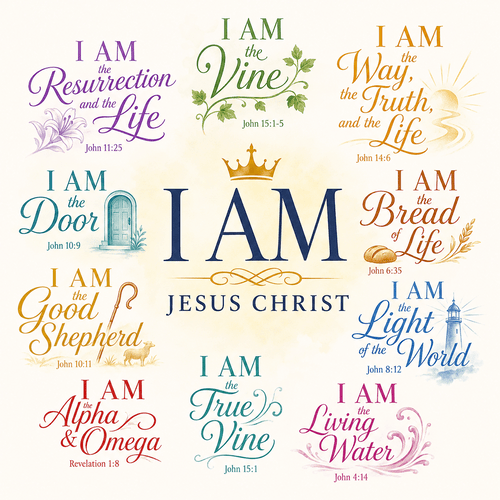
This post is the opener to a series. Jesus makes eight “I AM” declarations in Scripture—seven recorded by John in his Gospel, and an eighth spoken to John again decades later, in a very different setting, on the island of Patmos. Each one claims the divine name for Himself. Each one is tied to a miracle that proves the claim. And each one deserves its own careful look, which is exactly what the coming posts in this series will give it. This page is the map: what the “I AM” statements are, why the phrase itself is a claim to deity, and a guided tour of all eight before we go deep on each in turn.
JESUS’ “I AM” STATEMENTS AT A GLANCE
The “I AM” statements are eight declarations in which Jesus applies God’s own covenant name—first revealed to Moses at the burning bush (Exodus 3:14)—to Himself. Seven appear in John’s Gospel, each paired with a miraculous sign that validates it; John records only seven miracles in total, and most of them exist to authenticate one of these claims. The eighth appears in Revelation 1:8, where the risen Christ calls Himself the Alpha and the Omega. Together they are among the clearest, most deliberate claims to full deity anywhere in Scripture.
Why “I AM” Is Not a Throwaway Phrase
When Jesus proclaims Himself to be the “I AM,” He is invoking the divine name revealed to Moses at the burning bush (Exodus 3:14), where God identifies Himself as “I AM WHO I AM.” It is a name that transcends time, declaring an eternal and immutable nature—the same yesterday, today and forever (Hebrews 13:8). By adopting this title, Jesus is not claiming to be a man of God. He is claiming to be God incarnate. That single claim is the thread running through all eight statements, even as each one reveals a different facet of His divine character and role.
Jesus’ Jewish audience understood exactly what He was doing. Three moments in the Gospels show how the claim landed and what it carried.
| WHERE | WHAT HAPPENS | WHAT IT PROVES |
|---|---|---|
| Exodus 3:14 | God tells Moses His name is “I AM WHO I AM” | The name itself is a claim to self-existent, eternal being |
| John 8:58–59 | Jesus says, “Before Abraham was, I am”—the crowd immediately picks up stones | His hearers understood this as a direct claim to equality with God, punishable by death under their law |
| John 18:5–6 | Jesus says “I am he” to the soldiers sent to arrest Him, and they fall backward to the ground | The name carries the same authority in His mouth that it carried at the burning bush—He is not a victim but is laying down His life willingly (John 10:17–18) |
All Eight Statements at a Glance
Here is the full series in one table—every statement, its reference, the miracle that validates it, and the Old Testament root it fulfills. Each row below will become its own dedicated post as the series continues.
| STATEMENT | REFERENCE | VALIDATING SIGN | OLD TESTAMENT ROOT |
|---|---|---|---|
| I Am the Bread of Life | John 6:35 | Feeding of the 5,000 (John 6:1–14) | Manna in the wilderness (Exodus 16) |
| I Am the Light of the World | John 8:12 | Healing of the man born blind (John 9:1–12) | Pillar of fire (Exodus 13:21–22); Psalm 27:1 |
| I Am the Door | John 10:7 | Healing at the Pool of Bethesda (John 5:1–15) | Blood on the doorposts of Passover (Exodus 12:23) |
| I Am the Good Shepherd | John 10:11–14 | His own death, prophesied and fulfilled (John 10:11; 19:30) | Psalm 23; God as Shepherd (Ezekiel 34:11–31) |
| I Am the Resurrection and the Life | John 11:25 | Raising of Lazarus (John 11:17–44) | Isaiah 26:19; Daniel 12:2 |
| I Am the Way, the Truth, and the Life | John 14:6 | The temple curtain torn at His death (Luke 23:45) | “The way” of covenant faithfulness (Isaiah 40:3) |
| I Am the True Vine | John 15:1 | Water turned to wine at Cana (John 2:1–12) | Israel as God’s unfruitful vineyard (Isaiah 5:1–7) |
| I Am the Alpha and the Omega | Revelation 1:8 | John’s vision of the glorified Christ (Revelation 1:12–18) | God as the First and the Last (Isaiah 44:6) |
I Am the Bread of Life (John 6:35)
Picture a vast crowd, stomachs full from miraculously multiplied loaves and fish—yet their souls still hungering for something more. Into that moment Jesus declares, “I am the bread of life.” He is not offering another meal. Just as manna sustained Israel in the wilderness, He promises to nourish our deepest spiritual hunger, and this bread does not merely sustain life—it gives eternal life. In a world starving for meaning, Jesus offers Himself as the feast that truly satisfies.
I Am the Light of the World (John 8:12)
At the Feast of Tabernacles, where giant lamps illuminated the temple in memory of the pillar of fire that guided Israel through the desert, Jesus boldly proclaims, “I am the light of the world.” He is not claiming to be a teacher or guide; He is declaring Himself the divine light that dispels all darkness. In a world shrouded in the shadows of sin, confusion and despair, He offers Himself as the presence that brings clarity, hope and life—and His healing of a man born blind stands as the proof. He does not merely help us see; He gives sight to those who have never known light.
I Am the Door (John 10:7)
In a culture intimately familiar with shepherding, Jesus’ declaration of being “the door” would have resonated deeply. He is not saying He is an entrance; He is proclaiming Himself the exclusive means of access to God’s fold. The statement is both inclusive and exclusive—welcoming all who enter through Him, yet firmly asserting there is no other way. Just as the blood on Israel’s doorposts shielded them from the angel of death, and just as the temple curtain tore in two at Jesus’ death (Luke 23:45), He alone is the doorway into the Father’s presence.
I Am the Good Shepherd (John 10:11–14)
Jesus’ relationship with His followers is personal and sacrificial. He is not merely a shepherd; He is the good Shepherd, echoing God’s own self-description in Ezekiel 34. He is no hired hand who runs at the first sign of danger—He is the owner, the protector, who knows His sheep by name and lays down His life for them, exactly as He prophesied He would (John 10:11) and exactly as He did (John 19:30). The deathless One died, for His sheep.
I Am the Resurrection and the Life (John 11:25)
Standing before the tomb of Lazarus, with the stench of death heavy in the air, Jesus makes perhaps His most audacious claim yet: “I am the resurrection and the life.” He is not promising a future event; He is declaring Himself the very power of life over death. In raising Lazarus, He does not just perform a miracle—He previews His own resurrection and the life He offers to all who believe. In a world gripped by the fear of death, Jesus presents Himself as the answer to our deepest existential dread.
I Am the Way, the Truth, and the Life (John 14:6)
In the intimacy of the Upper Room, with the cross looming, Jesus distills His identity into a threefold statement. He is not merely showing the way, speaking truth, or offering life—He is all three, and His comprehensive claim leaves no room for alternatives. In a world of relative truths and multiple paths, Jesus stands as the absolute: the exclusive route to the Father, the embodiment of all truth, and the source of genuine life.
I Am the True Vine (John 15:1)
As Jesus prepares His disciples for His departure, He gives them this metaphor of the vine. Israel had been called God’s vine, but repeatedly failed to produce fruit (Isaiah 5:1–7). Jesus declares Himself the true vine—the genuine article, the fulfillment of what Israel was meant to be—and invites us into a relationship of utter dependence and continual nourishment. This is not a religion of rules, but a living connection to the very source of spiritual vitality, sealed by the sign of Cana, where He first turned the ordinary into the abundant (John 2:1–12).
I Am the Alpha and the Omega (Revelation 1:8)
Decades after the resurrection, in John’s apocalyptic vision, we hear Jesus’ ultimate self-declaration. He is the beginning and the end, encompassing all of history, all of creation, all of existence. Echoing God’s own words in Isaiah 44:6, this is a resounding affirmation of Christ’s deity and cosmic significance. The one who was born in Bethlehem and died on Calvary is the same one who spoke the universe into being and who will bring all things to their consummation. This statement closes the series where the whole Bible closes—with the eternal “I AM” holding every story, including ours, securely within His own.
WHAT THE “I AM” STATEMENTS ADD UP TO
These are not just claims of divinity; they are an invitation to relationship. The bread of life invites us to feast on His goodness. The light of the world beckons us out of darkness. The door welcomes us into God’s family. The good shepherd calls us to trust His provision and care. The resurrection and the life offers victory over death. The way, truth and life provides the path to the Father. The true vine invites us to abide in Him for fruitfulness. And the Alpha and Omega assures us that our stories are held securely in His eternal narrative.
As we reflect on these staggering claims, we are confronted with a choice. These are not the words of a mere moral teacher or a misguided prophet. They are the declarations of one who claims to be the eternal God incarnate, no less.
But here is the wonder that should bring us to our knees: this majestic, eternal “I AM” chose to become Immanuel—God with us. The infinite became infant. The Creator became creature. The Lord became servant. Why? So we might know God not as a distant deity, but as a loving Father. So we might have life, and have it abundantly.
As we stand in awe before these declarations, may we respond not just with intellectual assent, but with wholehearted devotion. For the “I AM” who spoke galaxies into existence now speaks a word of love over us: “Come to me, all who labour and are heavy laden, and I will give you rest” (Matthew 11:28).